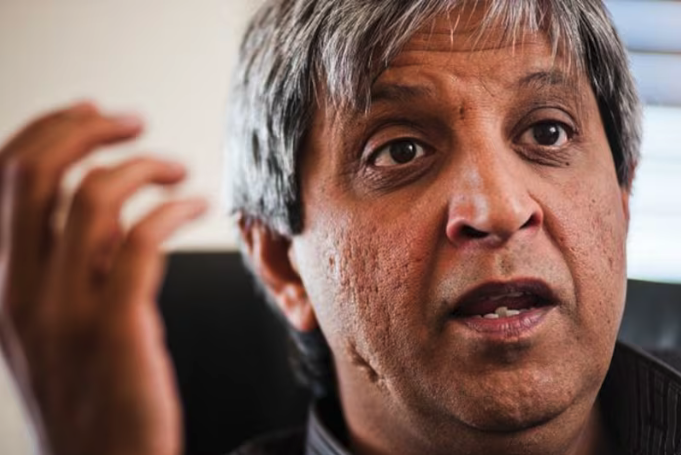
There is something almost touching about Adam Habib’s faith in Helen Zille. https://www.timeslive.co.za/politics/2026-08-18-only-zille-can-save-joburg-ex-wits-vc-habib-says-da-mayoral-candidate-perfect-for-the-job/ Johannesburg, he tells us, can apparently be rescued by one woman. If Zille does not secure an overall majority, he warns, not merely Johannesburg but “the city and South Africa are doomed.” For the job of mayor, he pronounces her “perfect.”
Perfect is an unusually generous adjective in politics, particularly when applied to a politician whose defects Habib himself has already catalogued. He has conceded that Zille holds what he called a “horrible hypocritical position on Gaza,” that her broader foreign-policy position is “problematic,” and that she would not be “great for economic inequality”. Yet he supports her because, as he put it, she can fix Johannesburg’s “water, electricity, roads, billing and corruption.”
There, in miniature, is Adam Habib’s politics. Principle matters until institutional convenience requires otherwise. Gaza is terrible, inequality is serious and Zille’s politics are problematic, but Johannesburg needs working taps. The administrator arrives and the activist is quietly asked to wait outside.
Habib was politically active during the 1980s and has long situated himself within South Africa’s liberation tradition. The interesting question is what became of those convictions when he acquired institutional power.
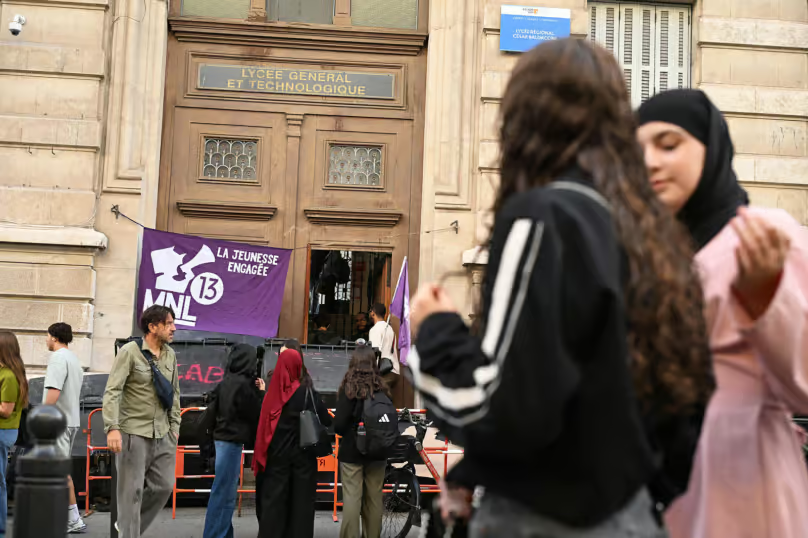
At Wits, Habib presided over genuine achievements. The university remained academically strong and financially stable, research output grew and outsourcing was ended. But the Fees Must Fall years revealed something about his political temperament. When protest became “disruptive”, Habib ultimately called police onto campus, a decision he acknowledged sat uneasily with his political history but nevertheless defended. A familiar pattern emerged: the administrator understood complexity and competing obligations, while those challenging institutional power were more readily cast as impatient or simplistic.
That pattern followed him to London.
SOAS, Gaza and Power
There is an obvious irony in Habib becoming director of SOAS, an institution synonymous with postcolonial and decolonial scholarship, only to find himself in conflict with activists protesting one of the defining colonial questions of our time. When Palestinian solidarity activism collided with university management, the familiar distinctions returned: legitimate protest versus disruption, free speech versus institutional order, activism versus misconduct.
Some of my disagreements with Habib were not conducted at a distance. We were members of the same chat group, and much of the exchange over SOAS, Gaza and Palestinian activism occurred there.
When concerns were raised about students facing disciplinary consequences in connection with Gaza protests, Habib responded with a lengthy defence of himself and SOAS. He reminded us that the university had called for a ceasefire, hosted Francesca Albanese, maintained an ethical investment policy and defended intellectual plurality. He referred to his own lectures at Cambridge, Oxford and elsewhere.
It read less like an answer than a recital of progressive credentials. Hosting Francesca Albanese and supporting a ceasefire may be commendable, but neither answers the more troubling questions raised by Habib’s own conduct: his berating of a Palestinian activist captured on video and SOAS’s treatment of Palestinian activists under his leadership. Progressive credentials are not a moral credit account from which one can draw down when confronted with conduct that appears to contradict them.
The exchange then became more revealing. Habib summoned Malcolm X, Martin Luther King Jr, Stokely Carmichael, the ANC, PAC, Black Consciousness and Palestinian resistance movements before dismissing critics as “silly individuals” pretending to understand complex questions. He also accused some of us of cultural and religiously chauvinistic attitudes. When I challenged him to identify anything I had written or said that justified so serious an accusation, no example was supplied. He left the chat group.
It was in this context that I invoked Malcolm X’s famous distinction between the “House Negro” and the “Field Negro.” The terminology is deliberately abrasive, but his point was about identification with power: the person drawn from an oppressed community who becomes so invested in the institutional world of the powerful that its interests become his own.
The relevance to Habib is not his colour but his relationship to power. Here is a man formed politically in opposition to apartheid, fluent in the language of resistance and decolonisation, who increasingly seems more comfortable explaining why institutions must restrain those challenging them. Habib treated the analogy as though his critics had failed an examination on African-American resistance theory. The point was simpler: what happens when someone formed within a liberation movement comes to identify more readily with institutional authority than with those confronting it?
The Teeger Affair
The same tendency appeared in the David Teeger controversy. When Cricket South Africa removed Teeger as captain of the national under-19 team, Habib condemned the decision, relying heavily on the fact that an earlier inquiry conducted by Wim Trengove had cleared Teeger. We debated this directly on the same chat group. Habib replied that he stood by “every word” of his position and framed the matter as one of equal application of “laws, rules and regulations,” warning that differential application was at the root of corruption.
But that was precisely what much of the criticism did not contend. The objection was not that Teeger should be subjected to a different standard. It was that Trengove’s reasoning itself was deficient. He treated Teeger’s remarks atomistically, severing his praise for Israeli soldiers from the legal, political and historical context in which it was made. The issue was whether the inquiry asked the right question: what did it mean for someone representing South Africa internationally to celebrate Israeli soldiers at that particular moment genocide was being committed?
Habib nevertheless seemed content to treat the fact that an inquiry had been conducted, and that it had cleared Teeger, as substantially settling the matter. But the existence of an inquiry does not answer a criticism directed at the reasoning on which its conclusion rests. Nor does a legal conclusion become comprehensive merely because an eminent lawyer reached it, particularly where the analysis excludes the very context necessary to understand the conduct being judged.
And Now Helen Zille
Which brings us back to Zille. Habib is right that Johannesburg is in desperate condition and that collapsing services punish poor residents most severely. He is entitled to believe that Zille would administer the city more competently than her rivals.
But administration is not politically neutral. Government decides where housing is built, whose neighbourhood receives investment, how public land is used, which communities remain geographically excluded and how historical disadvantage is addressed. A municipality is not merely a distressed plumbing company looking for an efficient chief executive.
Zille’s record on colonialism, race, transformation, inequality and Gaza therefore cannot simply be placed in another drawer. These are not unrelated political hobbies. They reveal something about the worldview through which public power is exercised. Yet Habib effectively says: yes, Gaza is a problem; yes, inequality is a problem; yes, there are profound political disagreements with Zille; but look at the water.
That reduces politics to municipal plumbing and confuses efficiency with justice. South Africans should know the difference particularly well. Apartheid did not lack planners, engineers, bureaucrats or functioning municipalities; its evil lay in the purposes to which administrative power was directed. No sensible person equates the DA with apartheid. The point is simply that competent administration has never been a substitute for justice.
Nor are the relevant questions merely whether potholes are repaired and bills arrive. Who lives close to employment? In DA administered Cape Town: who spends hours commuting from the Cape Flats? Where is affordable housing built? How is public land deployed? A city may function efficiently while reproducing profound exclusion.
Now, with Zille, Habib returns to the same division: Palestine belongs to one ledger, service delivery to another. Moral principle may be acknowledged, even eloquently, provided it does not obstruct the political arrangement he considers useful.
The Opportunist
There is a word for the pattern: opportunism. Not necessarily the crude opportunism of a man without beliefs, but something more sophisticated: convictions repeatedly adjusted when they become inconvenient to institutional power or immediate political utility.
At Wits, institutional necessity prevailed over disruptive protest. At SOAS, managerial authority prevailed when Palestinian activism crossed institutional lines, in a British political environment increasingly hostile to forms of anti-Zionist activism that challenge the prevailing establishment consensus on Israel. That context cannot simply be ignored. Habib now occupies and is sustained by the very British institutional establishment whose boundaries Palestinian activists have repeatedly tested.
His positions on Teeger and Zille therefore invite a more uncomfortable question. Is Habib, consciously or otherwise, playing to the institutional master that now feeds him? Defending Teeger after he celebrated Israeli soldiers credibly accused of genocide, treating the inquiry that cleared him as effectively dispositive, and now championing Zille while conceding that her position on Gaza is “horrible” and “hypocritical” all happen to place Habib comfortably on the side of positions far more congenial to the British establishment than uncompromising anti-Zionism would be. One cannot prove motive from coincidence, but in assessing an opportunist, the direction in which the opportunities consistently point surely matters.
The circumstances change, but the result is remarkably consistent. Habib’s position migrates towards the institution, authority or political arrangement he finds useful, while the language of resistance, decolonisation and social justice remains safely intact. That is the peculiar character of his opportunism: he retains the vocabulary of the radical while repeatedly finding reasons to accommodate power.
His treatment of critics completes the picture. They have failed to understand nuance. They do not appreciate institutional constraints. They misunderstand resistance politics. They are “silly.” They may even be chauvinists. Disagreement is transformed into evidence of intellectual deficiency.
Perhaps institutional power does this to former activists. Revolutions become easier to admire when safely located in the history department, while decolonisation becomes considerably less attractive when it arrives noisily at the administrator’s door.
Habib’s embrace of Zille therefore matters because it is not an isolated eccentricity. It belongs to a pattern in which principle repeatedly yields to institutional convenience, while the rhetoric of radicalism survives untouched.
The location of the speaker has changed. Habib once stood outside the gates demanding that power justify itself. Increasingly, he seems to stand inside, explaining why those rattling the gates simply do not understand the complexities.
That is not merely the journey from activist to administrator. It is the politics of opportunism.