Political project being built in the city is a direct challenge to constitutional democracy
In 1983, two signal events set the stage for the drama that unfolded over the next decade.
On August 20, the United Democratic Front (UDF) was formed in Cape Town, inaugurating a period of mass struggle that, along with the trade union movement formed after the Durhan strikes 10 years earlier, would shape many of the values on which democracy was founded in 1994.
On October 29, Inkatha moved against the growing power of the UDF and attacked students at Ongoye, the University of Zululand. The Ongoye Massacre was a grim overture to a decade of violence, including battles with hundreds of men in the field. As many as 20,000 lives were lost and the capacity for violenor developed by Inkatha, with the backing of the apartheid state, came within a whisper of derailing the negotiated path to democracy.
Unlike South African Defence Force chief Constand Viljoen, Inkatha Freedom Party leader Mangosuthu Buthelezi won massive gains in exchange for ordering his men to stand down. Around 2.8-million hectares of land, about 30% of KwaZulu-Natal, was placed under the authority of the Zulu king in a move that radically expanded the power of traditional anthority against the broader movement towards democracy.
The KwaZulu-Natal problem was not resolved with the concessions made to Buthelezi on the eve of the 1994 election. The political assamnations and extortion rackets, often operating with political backing, that now plague much of the country began in KwaZulu-Natal and remain centred in the province.
The increasingly well organised and sophisticated challenge to the values of the new democracy, which now directly targets the constitution and the courts, reaches back to former president Jacob Zuma’s rape trial in 2006. It had a strong ethnic element from the outset and over the past 20 years it has built a formidable political machinery that includes paid-for and sometimes bot-driven social media elements, an effective cultural project, traditional authority, extortion networks and armed men mobilised from hostels.
It has developed a capacity for semi-covert and open forms of violence. The semi-covert forms of violence were pioneered through the burning and killing that accompanied the extreme xenophobia of the All Truck Drivers Foundation and is thought to have taken as many as 213 lives between March 2018 and June 2019. In the riots of 2021, it swiftly moved through what began as a classic food riot to organise systematic attacks on infrastructure.
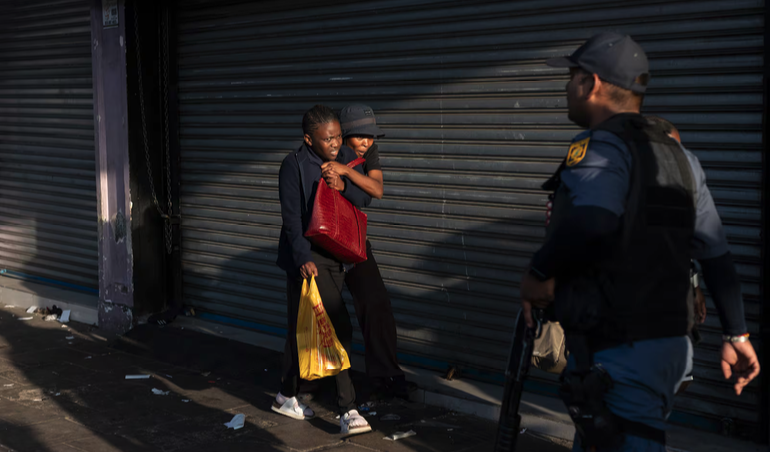
The return of armed and violent men to the streets has won significant public consent by initially targeting its intimidation and violence at migrants, people whose humanity has been steadily degraded in the public imagination for years. That consent has included a range of political parties, and a significant part of the media, government and the state. It has become routine to see police escorting rather than acting against violent mobs and for senior figures in the ANC, such as Nomvula Mokonyane, to describe violent mobs as democratic actors exercising democratic rights.
During the course of this year vast numbers of migrants, many documented and many with South African families, have been forced from their homes and jobs, and had their businesses destroyed, shut or seized. The state and the mob often acted against migrants in a pincer movement, with the state effectively deputising the mols.
Since May, March and March, often backed by the MK Party, have been openly intimidating and attacking documented refugees in Durban, with widespread complicity from within wider society. The events of the past few days have built on these attacks and raised fears of another attempt at the kind of insurrection violence that stormed through KwaZulu-Natal in 2021.
It is long past time to accept that South Africa has a serious KwaZulu-Natal problem, and to act, decisively, to address it.