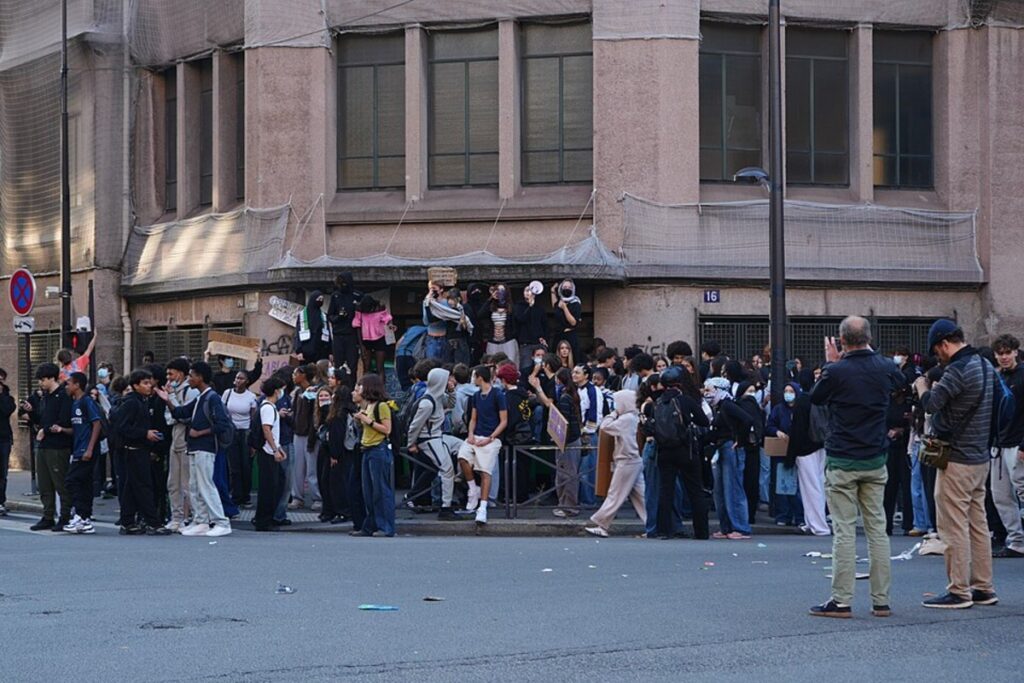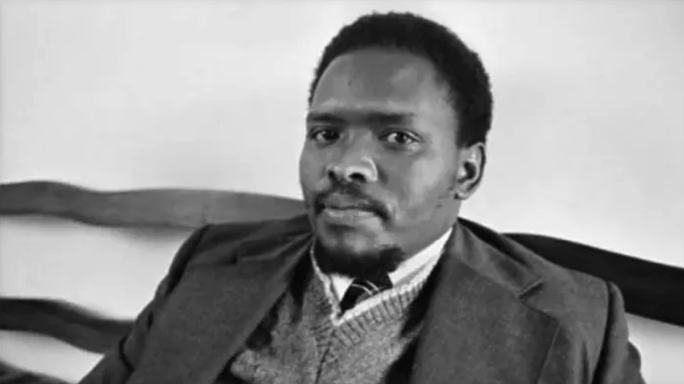
This year marks 50 years since the 1976 youth uprising, a turning point in South Africa’s struggle against apartheid. While triggered by the introduction of Afrikaans as the medium of instruction in schools, it would result in the creation of a new social force that birthed new movements of resistance and emancipatory politics.
The anniversary serves as an important reminder that opposition to white minority rule was not only about ending segregation. It was also a call for the establishment of a South Africa where oppressed people have a rightful claim to dignity, belonging and humanity.
A democracy not built on an “us versus them” logic, but on the belief in a society in which everyone can thrive. With the rise of xenophobic, ethnonationalist violence, this is important to remember.
For centuries, South Africa’s politics drew a sharp line between ‘insiders’ and ‘outsiders’, determining who belonged and who was left behind. Despite this system ostensibly no longer existing, the habit of a social order based on sorting who belongs and who doesn’t, who deserves and who doesn’t, remains deeply entrenched.
This has been used by xenophobic vigilante groups, posturing as anti-establishment, to fuel nativist narratives and to reproduce disposability, while using the language of democracy. And those deemed to belong outside of those boundaries are seen not as fellow human beings, but rather competitors for what little there is — disposable people who need to be removed for those deemed insiders to survive.
The target is not only migrant people, but also democracy itself. It is a deliberate, coordinated assault on democratic values and norms: creating a tolerance for intimidation and violence, rendering anti-Blackness as inevitable, and legitimising conspiracy and hate as political tools. And the consequences will not end with migrants.
Normalising an explicit embrace of intimidation and violence
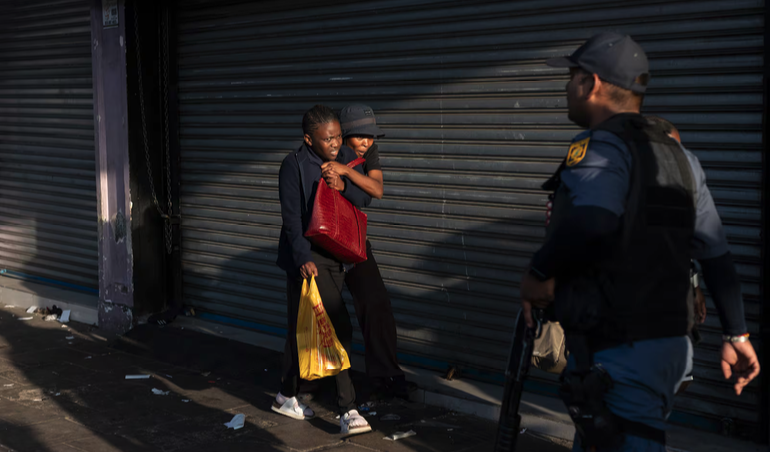
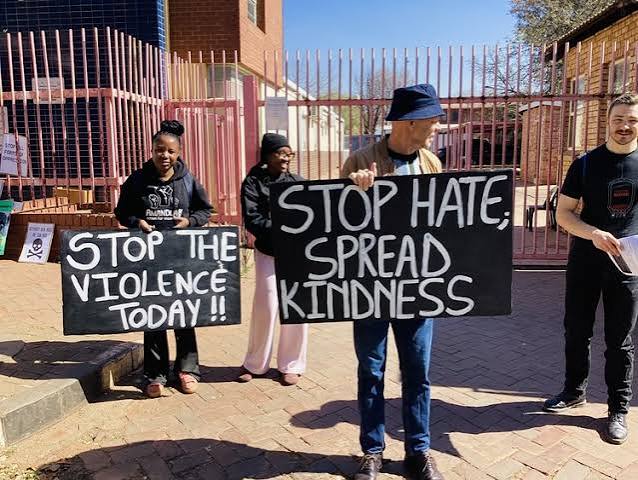
Xenophobic vigilante groups’ self-proclaimed 30 June 2026 deadline resulted in a wave of displacement, property destruction, repatriation, a humanitarian crisis and murders. This was preceded by media coverage that normalised anti-immigration sentiments, state complicity and abandonment.
It is not the first time. According to Xenowatch, xenophobic attacks between 1994 and December 2025 resulted in 696 deaths, 5,648 looted shops, and 128,758 displacements.
And while these vigilante groups claim their crusade is against “illegal foreigners”, their own actions undermine this claim. Documented people have been amongst those displaced and have had their homes targeted. Identity documents, visas and papers have not been enough to guarantee access to healthcare during a campaign to prevent migrants from accessing public healthcare facilities. And it is both documented and undocumented migrants who have been assaulted or had their shops looted.
This confirms that this was never about legality. It is a performance of a social hierarchy in which the boundaries of who counts as an ‘insider’ are being made smaller, at the expense of a country that recognises the inherent dignity and humanity of all. This is an attempt to build a society that is reorganised to explicitly embrace intimidation and violence against anyone deemed to be outside of those boundaries.
Anti-Blackness as xenophobic infrastructure
Xenophobic vigilante groups in South Africa have adopted the same strategy as global anti-rights movements and other illiberal actors: start by attacking a particular group — in this case migrants — and gradually expand the erosion of democratic protections beyond the targeted group.
During a televised discussion, Zandile Dabula, formerly the president of organised hate group ‘Operation Dudula’ and now attached to the anti-immigration political party Action SA, claimed that “before the ANC took over, we did not see all of these migration issues”. This suggests a longing for the imaginary “good old days” of colonialism and apartheid that included stripping Black people of their citizenship. 176 years of slavery and indentured labour.
The infrastructure of xenophobia in South Africa is built on anti-Black racism.
For example, earlier this year, xenophobic slurs were used against a South African police spokesperson for not speaking isiZulu. A mother from the North-West who speaks Setswana and Afrikaans was labelled a “foreigner” during an intimidation campaign to keep migrant children out of public schools. Stones thrown in places like Yeoville, Malvern and Hillbrow were indiscriminate. These are not anecdotal exceptions: in the xenophobic violence of 2008, a third of the 69 people killed were South African.
Whenever there’s an outbreak of xenophobic violence in South Africa, it is Black people who are profiled and constantly required to prove whether or not we belong.
And it will not end with Black people. The result will be a society that keeps expanding the “outsiders”. Already parties and individuals that have been central actors in the current wave of violence are homophobic and increasingly using Islamophobic rhetoric.
Hate and conspiracy as a political tool
In the last local government elections, the political parties which made gains were those with campaigns steeped in xenophobia and ethno-nationalism, and generally accepting of conspiracy and hate as political tools. This was reaffirmed in South Africa’s 2024 general elections by the rise and gains of parties like uMkhonto weSizwe, Patriotic Alliance, Action South Africa and the National Coloured Congress.
And as we approach the local government elections, xenophobia has yet again become “electoral fuel”. Whether or not this will yield the results, it has fundamentally shifted the country’s politics by mainstreaming the undermining of democratic values and “the grammar of removal”.
And with each election, political parties have become more accommodating of this brand of politics. So, when it became clear that the ANC’s electoral fortunes were on the decline, it hardened its immigration stance. Even the EFF, the only major political party that has been relatively consistent in its denouncement of xenophobia, undertook inspections at restaurants to “check ratios of foreign to local staff”.
It seems like we are heading in a direction where sorting through people will be not only an acceptable way of doing politics, but also the only way.
This is not to romanticise the state of South Africa’s democracy, which has not yielded its promise for the majority. It is not perfect. Wages have stagnated. Inequality continues to rise. Unemployment continues to be among the world’s highest. Collusion between the state and private capital is the order of the day. Accelerated accumulation at the top continues unabated. Public services are deteriorating, while the country rapidly urbanises without effective planning or adequate infrastructure.
But what if we thought of democracy not as something that in and of itself will change these conditions, but rather as a system — even if imperfect — that can be renewed to change this? A system that can enable us to organise for and practice inclusive alternatives, instead of a society in which ‘insiders’ stay shielded and the ever-expanding ‘outsiders’ remain on the margins.
Unless we do this, those opposed to democracy and their enablers will keep offering a false sense of belonging to people who are left out. And their version of belonging includes forced expulsions; an infant dying because they were denied healthcare; babies blocked from being vaccinated; homes looted and ransacked; families sleeping outside in cold conditions; extortion, including by police, becoming institutionalised. These are just a few examples of the indignities they want us to accept, until all institutional guardrails and protections are lost.
And they want us to surrender, to retreat into the shelter of safety, as if this is all inevitable. Fear is the tactic. Individuals and organisations face threats of violence for opposing inhumane vigilante tactics. Already exploited workers are being unfairly dismissed, without being paid what is due to them. And they have also created conditions that require Black people to have to prove our belonging with identity documents — as if there’s a return to the pass law days of the past — or face possible violence or extortion.
Basically, a continuation and escalation of an inhumane discretionary architecture that will leave no one unscathed, except those who are benefiting from the current status quo.
For those of us who have justice as our goal and believe that democracy can be transformed as a pathway to it, quiet acceptance is not an option. Our discontent has to be transformed into action, alongside our communities, and everyone committed to a South Africa where we can all thrive. Right now, this could be in the form of supporting humanitarian efforts and working with neighbours to keep our communities safe, as well as documenting and bearing witness.
Beyond this, the elite capture of democracy has to be challenged. This will require bold and visionary politics, built on sustained collective efforts, to fundamentally restructure the economy, expand the social safety net, and confront the conditions that give rise to actors opposed to democracy.
Now is the time to start this essential and transformative task of creating the democracy we deserve, as it has been since its dawn in 1994.
Koketso Moeti has a long background in civic activism and, over the years, has worked at the intersection of governance, communication, and people power. Follow her on Twitter at @Kmoeti.