[This is a follow up of the previous report about the explosion of anger after the eviction of 87 year old Maricarmen in Madrid, and the political consequences, which you can read here: https://www.facebook.com/jorge.martin.1917/posts/pfbid0gycZWVVqkNrKrTduaZCJN7yDGNMHW7WA9daGSVc6sBsPyNMEkraXJyM9aMYZyCcWl ]
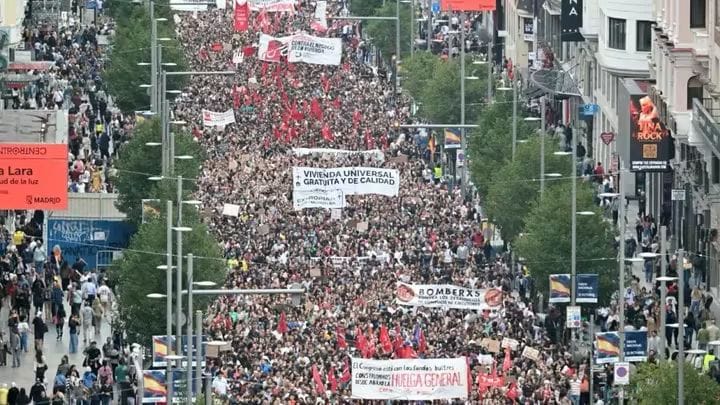
Over the weekend there have been mass demonstrations across Spain, the largest one being in Madrid on October 3, with about 200,000 people. Four different columns converged bringing protesters from the capital’s working class neighbourhoods.
The demonstration, called by the Renters’ Union (SI) was headed by a large banner calling for a general strike in large letters, accompanied by the three demands of the movement (50% lowering of rents, indefinite rental contracts, expropriation of vulture funds), which go much further than the mild government reforms contained in the decrees defeated on Friday in parliament.
The presence of revolutionary socialist and communist organisations was noticeable, with a sea of red flags waving.
There were also large demonstrations in Seville, Granada, Malaga, in the Basque Country, in Oviedo, in Galicia, in Burgos, in the Canary Islands. In Valencia a huge crowd broke through police lines to get to Palau de les Arts where a “Real Estate Summit” was taking place. In Barcelona the protest was postponed because of a flooding danger alert.
Last week, the PSOE government tried to capitalise the movement and to deactivate the pressure from below by proposing two decrees with mild reforms. That backfired, as the decrees did not get a parliamentary majority, and now the ball is firmly on the court of the mass mobilisations on the streets.
The Renter’s Union has proposed a general strike and the idea has caught the imagination of millions. On Saturday, Oct 3, El Diario published an opinion poll revealing that 73% of the population would support a general strike over housing issues, including over 60% of those who vote for the right wing parties PP and Vox (https://www.eldiario.es/economia/mayoria-ciudadanos-incluidos-votantes-derecha-apoyarian-huelga-general-vivienda_1_13557680.html)!
Ten days ago, the political mood in Spain was completely dominated by the question of migration (after tens of thousands breached the Spanish border in Melilla in July) which was used to promote all sorts of reactionary ideas.
Many, including many on the left and even on the revolutionary left, were lamenting the so-called “rise of reaction”, depicting a pessimistic vision of a “shift to the right” if not the immediate danger of fascism coming to power.
The truth is that the crisis of capitalism has led to a massive crisis of legitimacy of all institutions of the bourgeois regime. If no clear anti-capitalist anti-establishment answer is given by the left, then the rise of anti-establishment demagogues of the right is inevitable, though they are far from being in a strong and solid position.
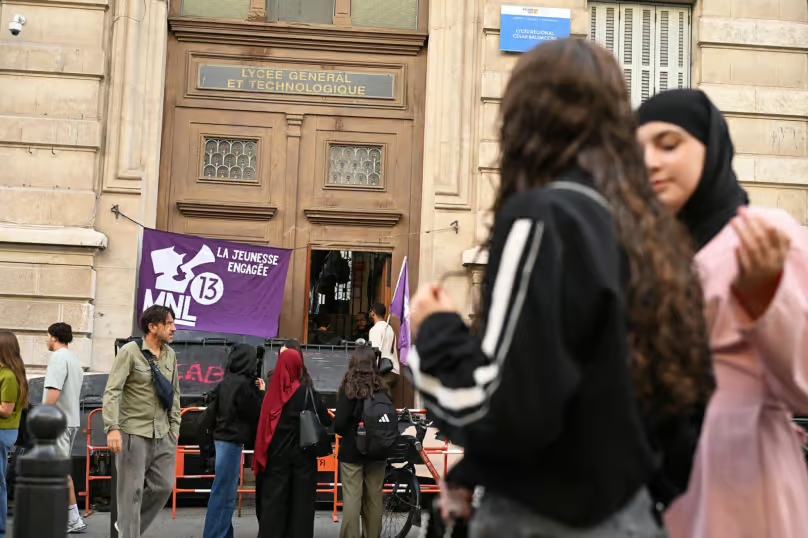
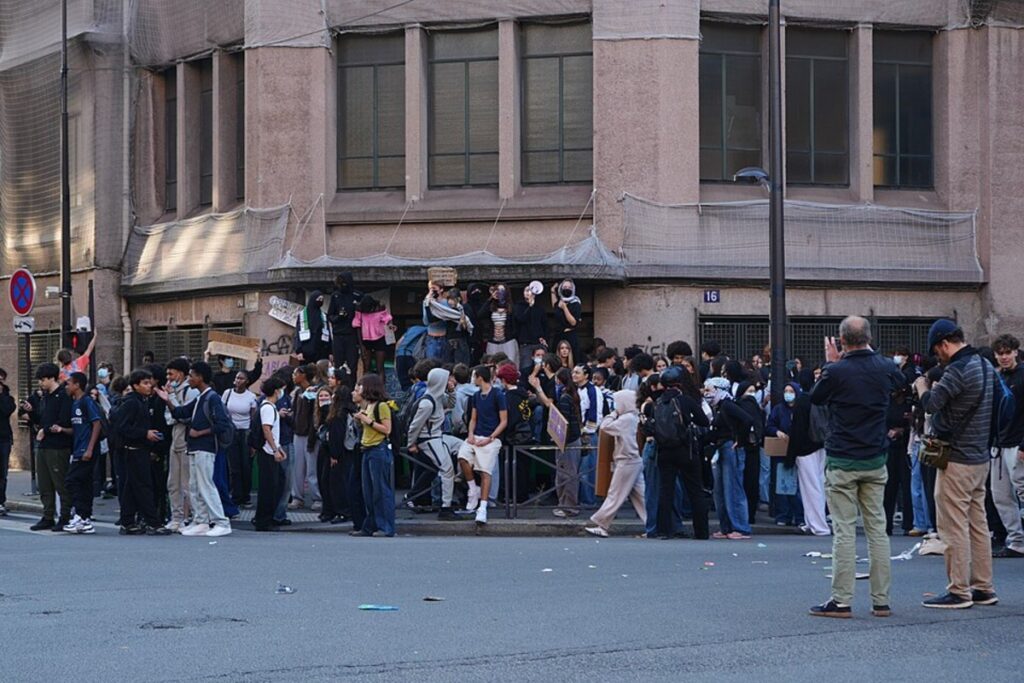
Whenever an alternative is offered on the left, the situation can changed quickly and in an explosive manner. This is what we have witnessed in France with the school student protests and this is what we have witnessed in Spain over the question of housing rights.
The same opinion poll showed that 83% of the population supports, totally or partially, the demands of the movement, but that includes 65% of those who vote for the right wing PP, and, even more significantly, 65% of those who vote for Vox!!
The eviction of Maricarmen, the defeat of Sanchez’s decrees and the Sol encampment were hammer blows which shook consciousness, but of course it had already been shaped by the deep housing crisis which has affected Spain particularly since 2008.
The dominant idea today, which has become the established common sense, is that housing cannot be a commodity, but rather it has to be a right. The renter’s union slogan currently is “to put an end to the housing business”. This is a profound conclusion, which goes directly against the foundations of the capitalist system and is accompanied by concrete demands (rent controls, expropriation of corporate landlords, a ban on evictions, etc) which go precisely in that direction. The question of housing cannot be solved within the capitalist system and many in the movement are already starting to draw that conclusion.
The events in Spain in the last few days contain many lessons. One of them is that the only effective way of cutting the grass from under the feet of reactionary demagogues is to offer a bold anti-capitalist program to deal with the real social problems which they use to advance their ideas. At the same time, the small fascist gangs which organise on the fringes must be cleared off the streets through the militant direct action of thousands.
What next? It is likely that on Monday morning Pedro Sanchez will call for early elections in November. For two reasons. One is that he now has an issue on which he can fight the right. He will say: “I wanted to solve this problem, but didn’t have a majority, vote for me and I will do it”. Elections are scheduled for mid-2027, but Sanchez will be inclined to seize the initiative now. It seems that internal polling commissioned by PSOE show his situation now is still precarious and he may not win the election if called, but on the other hand going exhausting his mandate risks creating an even worse balance of power.
The other reason is that the ruling class is in panic at the potential implications of this movement. Calling an election would be the best way to provide a safe electoral channel for the anger in the streets and avoid a general strike.
The housing movement has achieved more in 10 days of mass action than in years of parliamentary debates. This is the way forward. A general strike would not in and of itself solve the question, but would massively shift the balance of forces. A 24h protest strike cannot overthrow capitalism, but nevertheless it makes the working class aware of its own power, that is why the trade union leaders fear it.
The movement in Spain is taking place simultaneously, not by chance, with yet another mass social explosion in France. The brutal police repression of the school student protest movement has thrown petrol to the flames. Already different sections of the working class were mobilising, now they are joining together.
All major trade union federations have called for solidarity with the school student movement on October 6, though typically, they shy away from making a clear call for a general strike. The peasant’s organisation Confederation Paysanne has also called for solidarity with the students and appealed for its members to bring tractors to the demos.
The question of the physical defence of the school students brutalised by the police has taken a central place in the movement.
UnitéCGT, the militant left wing of the main trade union federation, has correctly posed the question of the need for a general strike and factory occupations:
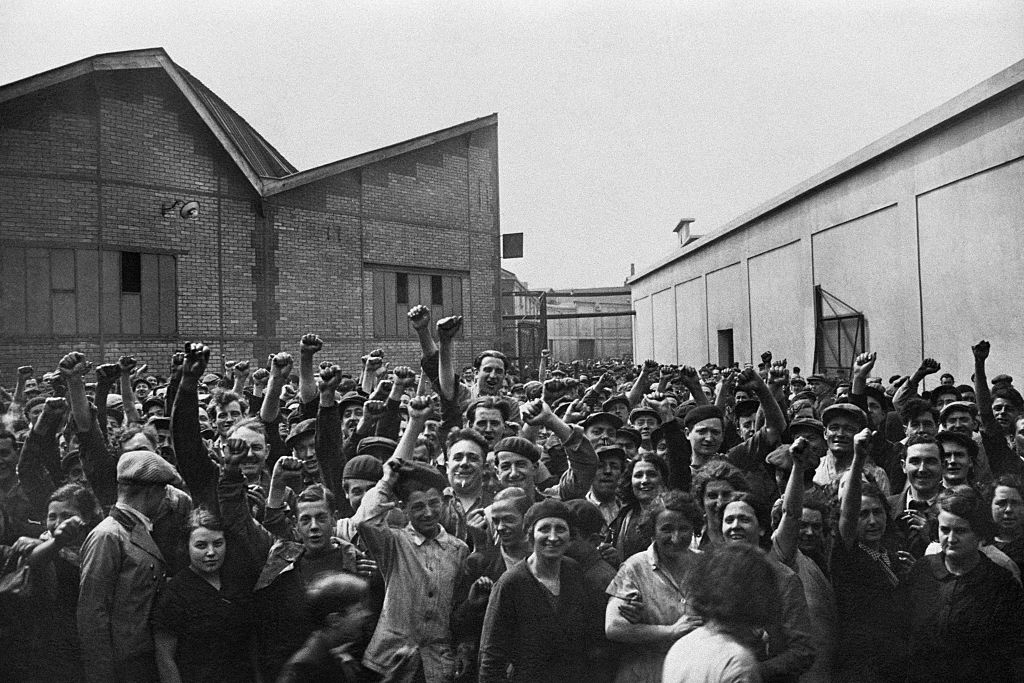
“This therefore implies, like the call for a general strike in May ’68 in solidarity with the students and in response to workers’ demands, a call for a national interprofessional strike as quickly as possible.
“This also implies that we must raise awareness, everywhere, of the absolute necessity of engaging, all of us together, immediately in the struggle through strikes, action on the economy, and the occupation of workplaces.
LET’S MOBILIZE, THROUGH STRIKES WHEREVER POSSIBLE, TO AMPLIFY THE MOVEMENT, UNITE ANGER, AND PREVENT POWER FROM TOUCHING OUR CHILDREN!”
If Spain and France are boiling over, surely Italy is not far behind. In Belgium there have also been school student protests.
Onwards to a European red autumn!