Ulysse Rabaté, a political science researcher at the University of Paris-8 and co-founder of the Quidam association for popular education, considers that high school mobilization already represents a tipping point in contemporary French political life.
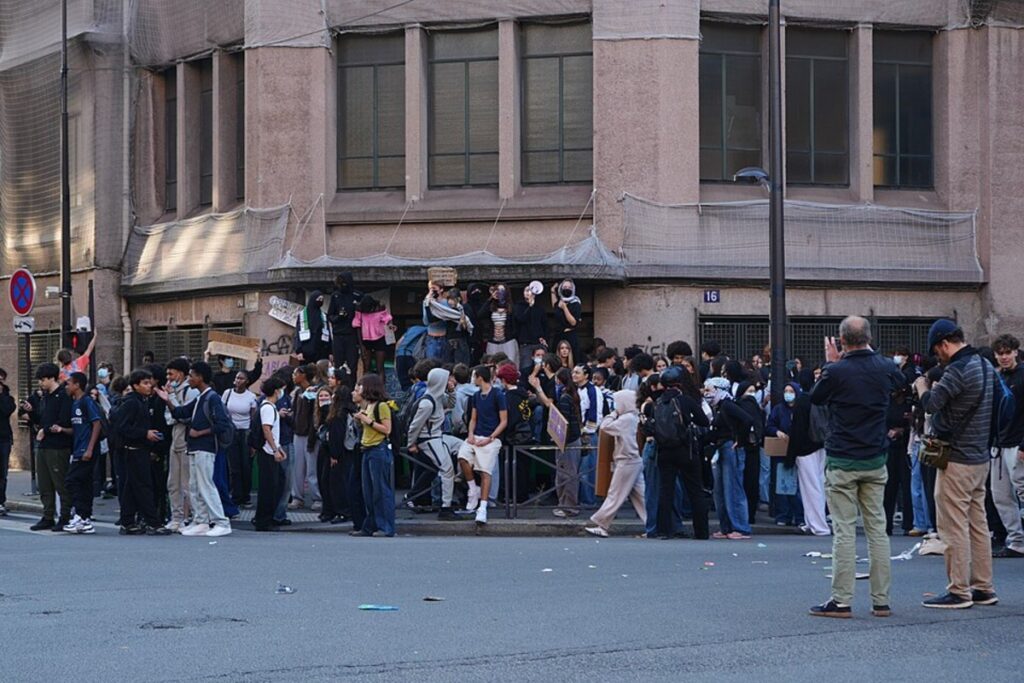
Let’s say it right away: the movement of high school students that has crossed the country in recent days is impressive. Its echoes are numerous and obviously uncertain. But by its magnitude and trajectory, and by its polyphonic appearance on the political agenda, this mobilization is already a tipping point in contemporary French political life.
The importance of what is happening can be measured by the impressive reactionary outcry to try to impose the idea of a movement with dubious, violent or recovered motivations. The movement is in fact a bright revealer of the political irresponsibility of the power in place. His objective opponents are right to take him seriously.
The movement presents at this stage some characteristic and structuring traits, which we will try to list here through the prism of a sociology of mobilizations necessarily re-exterged by current events. The elements developed do not claim to be exhaustive and must be read as many questions, still open.
1- The movement comes from below
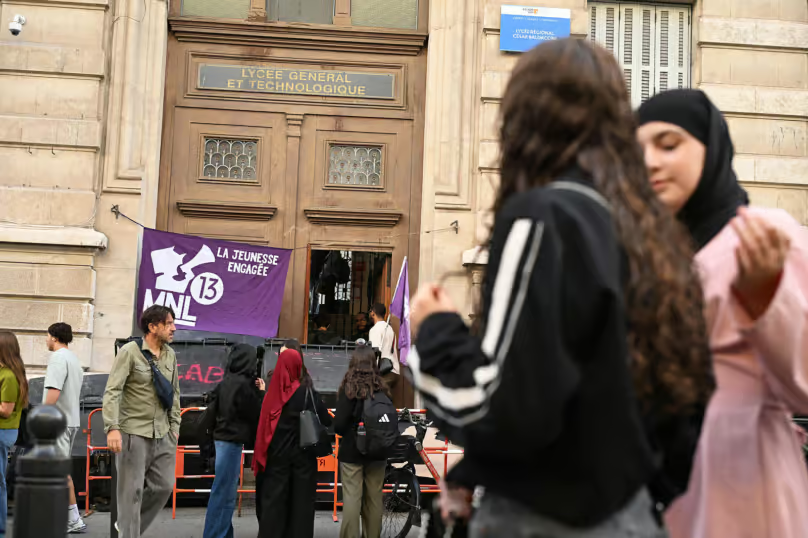
This is the first and essential feature of current events: today expanding throughout the country, the high school movement was born in the popular high schools of the Parisian suburbs, in Seine-Saint-Denis and in the Val-de-Marne. What is highlighted by students and staff is no longer really the traditional “lack of resources” but the collapse of reception conditions in institutions where the vast majority of children from families living in popular neighborhoods are educated.
The first demands are those of equal treatment, formulated from the point of view and from a particular experience of inequalities, claiming the social identity of popular neighborhoods. The codes of the neighborhoods make up the aesthetics of this mobilization, from words to clothing. Overturning the stigmas, the movement shows the convergence between street culture and political stance.
2- The centrality of neighborhoods in the emergence of the movement is also read in its media treatment and repression
The images of frontal opposition between these groups of young people and the police may have (re)re) made us think of those of the urban revolts of the summer of 2023. Continuity is observed in the place occupied by the issue of police violence from the first days of the movement. The grenade shooting at close range on a young minor in Saint-Ouen-l’Aumône (95) on Monday, September 28 – which was filmed – and the dething of a young high school student in Tours are therefore events that already include the history of the mobilization. In this sense, the high school movement carries the legacy of recent forms of protest inscribed in the universe of French popular neighborhoods, and bears their cultural imprint.
The emergence of popular youth in the political field, through this high school movement, is part of a recent history already very dynamic: from the spontaneous mobilizations of young people in the neighborhoods during the covid-19 health crisis to the exemplary electoral mobilization of the summer of 2024 against the extreme right, through the revolts of 2023, young people from the popular neighborhoods have objectively occupied the political field in recent years, even if these democratic ambitions are constantly denied or stigmatized.
Finally, and this is a fact that we consider fundamental in the analysis, this youth movement is part of a “war of position” in the cultural struggle against the extreme right: public figures claiming neighborhoods are now numerous to “take a position” and feed a cultural order that clearly activates a line of conflict around the issues of racism and democracy. The mobilized youth is clearly inscribed, by its references, in this cultural order. The 2027 presidential election necessarily structures these positioning dynamics. It is not only identified as a perspective, but as a concrete and very present fact that justifies the mobilization and gives it weight.
3- The movement is “pro-political”
This is a striking feature of this mobilization, which is probably not emphasized enough: the elected officials who go to the blockades are well treated, even celebrated. And 2027 is mostly identified as an outlet for anger. While for years, the widespread discourse has been that of a break between young people and politics, a break in popular neighborhoods and politics, these mobilizations send a totally opposite message.
Elected officials who come in a scarf are not accused of “recovery” by the protagonists, but are pragmatically welcomed as a welcome support to make the denunciation of injustices resonate. Why deprive yourself of it? The challenge of the political world and institutions is consubstantial to the birth of the movement and its original demands. The watchwords are not located in a “degagist” repertoire but focus on concrete requests: teachers, nurses, class hours, chairs, tables.
The movement does not define itself “ast” established forms of commitment, nor against adults (in terms of electoral sociology, it could, however!), and is characterized by a strong solidarity between students and staff of National Education. The precariousness of what Bourdieu called “the left hand of the State” is manifested by this solidarity of destiny staged during the blockades, with, for example, an important role of educational assistants (AED) in the mobilization and legitimization of students’ demands.
4- The movement is more broadly the vivid expression of a dynamic of circulation between popular cultures and political culture
From the first hours of the mobilization, it became clear that the emergence of it was autonomous from any established political structure. Parties and unions have no establishment in the high schools concerned and are “invisible” in the first blockades. This does not mean, of course, that politics is absent. We then discover that spontaneous steps to document these conditions existed on social networks, that successive generations have passed on the experience of inequality.
References such as the yellow vests are handled and reappropriated by a public discourse which, on social networks, demonstrates a manifest collective awareness of the general political context. The multiplication of students’ speeches in front of high schools shows a controlled speech, addressed to society regarding living conditions in schools, and in popular neighborhoods. The register of the feeling of injustice, well known to neighborhood sociologists, is omnipresent and is articulated with a demand for equality.
Adversity, accelerator of politicization
As in many processes of mobilization “from the bottom” throughout history, adversity has been an accelerator of politicization, largely underestimated: the subject that enters the public political debate today has existed for several years in ordinary protests and conversations. A political culture nourished by popular cultures appears here, more than by traditional channels of politicization. This is undoubtedly what makes this movement unrecoverable, in the good sense of the term: the expression of an “already” ahead of the political world.