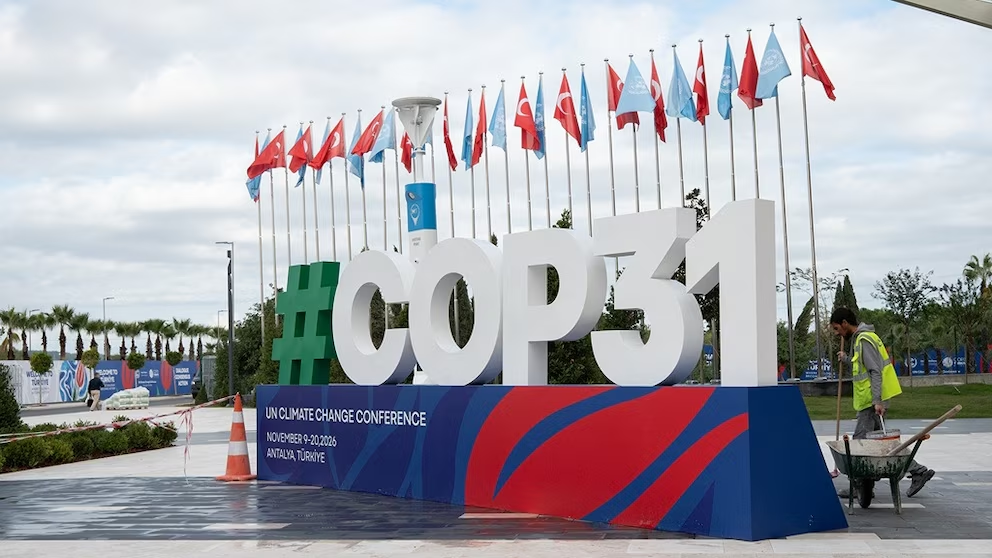
Next week the Climate Conference of the Parties (COP) moves to Antalya. From 9 to 20 November, delegates to COP31 will gather on Türkiye’s Mediterranean coast, with Australia’s Chris Bowen acting as “president of negotiations” and the Turkish hosts branding it the “implementation COP”. Climate and social justice activists are entitled to ask a blunt question: implementation of what, and for whom?
A year ago, writing after the Belém COP, we argued that COP30 had entrenched the crisis of climate politics. Nevertheless, it must be recognised that the COP remains the only global forum in which the most vulnerable countries sit at the same table as the biggest polluters. Its commitments, however weak, give movements something to hold governments to. But the mid-year negotiations in Bonn showed how far the UN climate process has been constrained, fitted with a straitjacket tailored by the petrostates and stitched by the fossil fuel corporations. Activists who travel to Antalya should be clear-eyed: a breakthrough on emissions is unlikely. Those who go need to use the time to build alliances across the Global South and to plot an independent path.
In this article we want to make the case for climate and social justice activists and especially trade unionists to stop primarily organising their hopes around a mitigation agenda the COP has so far failed to deliver. To rebuild a climate justice movement and win poor and working people to an eco-socialist agenda it is necessary to place the protection of poor and working-class communities from a crisis that is already here at the centre of our demands. Adaptation, the building of resilience to withstand the impact of the climate crisis, is not surrender, as some might accuse us. Organised properly, it is the most direct route to jobs, to public investment and to the kind of mass movement that can eventually break the power of fossil capital.
A process in a straitjacket
Belém ended without a fossil fuel phase-out. Oil-producing states blocked binding language, and the proposal for a formal roadmap to “transition away from fossil fuels,” the modest promise made at COP28 in Dubai, was dropped from the final text. What survived was a voluntary roadmap sitting outside the negotiations, to which only a handful of countries have sent submissions.
The Bonn intersessional in June this year (2026) showed how tight the straitjacket has become. Fossil fuels were not even a formal agenda item. Colombia had to point out that the words “transitioning away from fossil fuels” had quietly vanished from the summary of the Global Stocktake dialogue. Speaking for the Like-Minded Developing Countries, Saudi Arabia described that dialogue as a “non-prescriptive space with a focus on finance”, warned others against “cherry-picking” the Stocktake and pushed carbon capture as the answer. Fiji’s negotiator publicly accused Saudi Arabia and India of “undermining” climate science in light of their opposition to references to 1.5°C, to misinformation and even to tipping points.
The result was paralysis. The mitigation work programme failed and was pushed to Antalya under “rule 16” — the procedural rule that simply carries an unresolved item over to the next session, with no agreed text to build on. The global goal on adaptation suffered the same fate. The final draft was entirely in square brackets. Five consecutive IPCC meetings have now failed even to agree a timetable for the next assessment report.
The petrostates do not act alone. The United States formally left the Paris Agreement on 27 January 2026 and has announced its withdrawal from the UN climate convention itself. The Trump administration has reversed modest climate related initiatives aimed at reducing the US high level of emissions. Like the war in Ukraine, the war on Iran has been disastrous for efforts to reduce the profitability of oil and gas. Since the US and Israeli strikes of 28 February and the closure of the Strait of Hormuz, Brent crude has traded above $100 a barrel. BP’s profits more than doubled on the back of the war, reaching $5.7bn in the second quarter, its best in four years, while the company announced it would “move further away from renewables”. War, it turns out, is excellent for the fossil fuel business.
Militarisation and the growth of the armaments industry is booming and yet its contribution to global emissions is not calculated and attempts to put this on the COP agenda have so far failed.
This is the context in which the Türkiye presidency offers an “action agenda” built on voluntary targets, such as raising electricity’s share of final energy from about 20% to 35% by 2035. Bowen himself concedes that the action agenda and the negotiations are “separate things”. The danger is that pledges are made in one room while the real business of blocking is done in the other.
Temperatures rising
All the while the climate crisis deepens. 2024 was the first calendar year in which average global temperatures exceeded 1.5°C above pre-industrial levels, reaching about 1.6°C on the Copernicus measure. 2025 was the third-warmest year on record, at 1.47°C, and the three years from 2023 to 2025 together averaged above 1.5°C for the first time. All of this happened before the current El Niño arrived.
Now a “super” El Niño, the periodic warming of the eastern Pacific that releases stored ocean heat into the atmosphere, is building on top of the warming we have caused. In September, sea temperatures in the key Niño 3.4 region of the Pacific reached an all-time high of 29.70°C, above the peaks of the great El Niños of 1982–83, 1997–98 and 2015–16. Japan’s weather agency says the event has reached its “strongest intensity on record”. According to the Copernicus Climate Change Service, global sea surface temperatures hit a record 21.05°C in September. August 2026 equalled July 2023 as the hottest month ever measured, and September, at 1.63°C above pre-industrial levels, was the second-warmest September on record. A new run of months above 1.5°C began in August, and Copernicus expects it to continue into 2027, because global temperatures peak some months after El Niño itself. “We may have a record-breaking 2026, followed by a record-breaking 2027,” warns Copernicus director Carlo Buontempo. “Crossing the Paris Agreement’s long-term limit is only a matter of time.”
In Southern Africa global heating is having a devastating impact. In January, floods across Limpopo, Mpumalanga, Mozambique and Zimbabwe killed more than 100 people and displaced hundreds of thousands. Now we face the opposite extreme. The Climate Impact Lab projects around 1,200 additional heat deaths in South Africa between September 2026 and February 2027 and some 451,000 globally. El Niño years in our region bring drought, failed harvests and rising maize prices. This time they arrive on top of a war-driven shock to fuel and fertiliser prices. Food insecurity and hunger is set to become even more acute in the richest country of the region.
Those who die in heatwaves are not the residents of air-conditioned suburbs. They are the elderly in tin shacks, outdoor workers, farmworkers and informal traders. Those who lose everything in floods are the families forced by apartheid spatial planning and land markets onto floodplains and unstable slopes. Hence, the climate crisis must be understood, in the first instance as a class question.
A jobs and livelihoods bloodbath
The paralysis in climate action is not only an environmental failure. It is producing a jobs and livelihoods bloodbath.
It is striking that the one major economy treating the transition as an industrial project is China. In 2025 clean-energy sectors made up 11.4% of China’s GDP. Clean-energy investment reached roughly $1 trillion, about four times what went into fossil fuel extraction and coal power and drove more than a third of the country’s economic growth. In March 2026 alone China exported 68 GW of solar equipment, including 10 GW to Africa. Whatever one thinks of the Chinese model, it shows what planning and state-led investment can do.
Elsewhere, governments are paralysed by austerity, debt and the political power of fossil capital. They neither protect the old industries nor build the new ones. South Africa is a stark example. Unemployment rose to 43.7% in the second quarter of 2026, with 345,000 more people out of work in a single quarter. While unemployment for young people between 15 – 24 exceeds 60%. At the end of 2025 ArcelorMittal shut its Vereeniging steelworks, cutting 3,500 jobs, and issued retrenchment notices at Vanderbijlpark. Around 61,000 manufacturing jobs disappeared in the last quarter of 2025 alone, and unemployment in the Vaal Triangle exceeds 55%. Mining and agriculture shed a further 41,000 jobs in the second quarter of 2026.
Coal and steel communities are abandoned to the market, while the green industries that could replace them are imported rather than built. Meanwhile, droughts and floods destroy the livelihoods of small farmers, fishers and informal workers, most of whom have no unemployment insurance, retrenchment package or other safety net to fall back on.
The “Belém Action Mechanism” for a just transition, which Bonn moved towards operationalising, will not on its own change this. As we argued last year, it still has no money and no plan for re-industrialisation. A mechanism that cannot fund a single retrenched steelworker’s livelihood is not yet a just transition. Trade unions and movements should fight to give it resources and teeth; otherwise, it will remain little more than a just-transition brand.
Why the movement must shift its focus
For three decades the climate movement has organised largely around mitigation: emissions targets, carbon budgets and the 1.5°C line. That was the right fight, and cutting emissions remains essential. But we must be honest about where it has led. The 1.5°C goal has effectively been breached. Mitigation has been negotiated into a contest of national pledges that the powerful ignore at will. Worse, it has been captured by carbon markets, offsets and “net zero” accounting that allow polluters to buy their way out of doing anything.
There are four reasons to shift the weight of our demands towards adaptation.
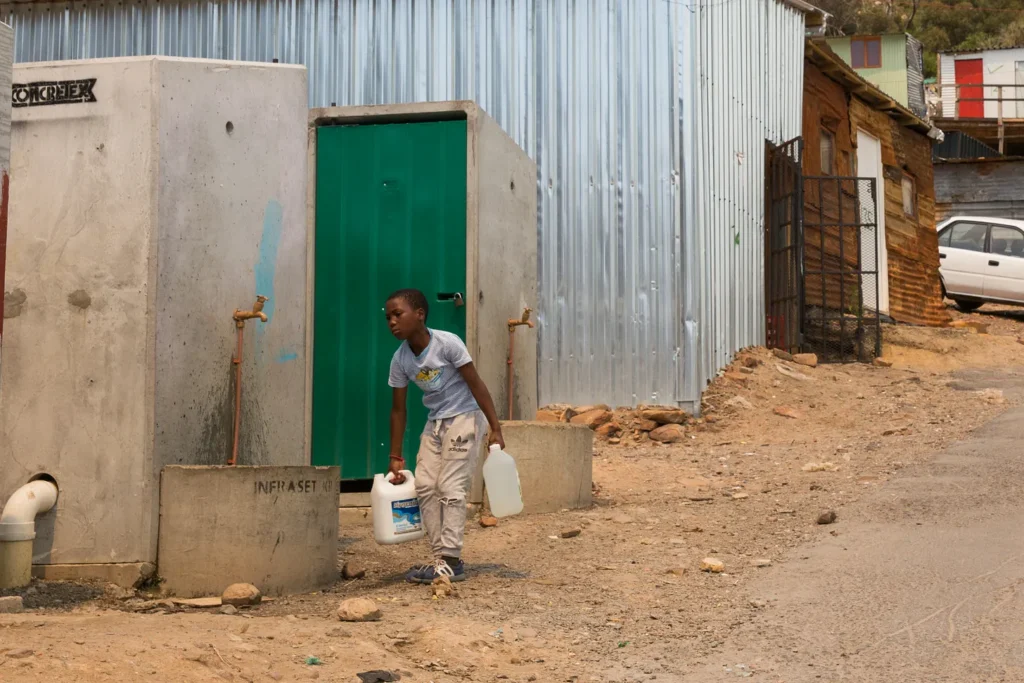
First, adaptation is where the immediate lives and livelihoods of the working class are at stake. A family in Alexandra or Mthatha cannot wait for the global carbon budget to be settled. It needs a home that is not prone to flooding, taps that don’t run dry and a clinic that can cope with a heatwave.
Second, adaptation is the ground on which the rich countries are most exposed. Even the COP’s own commitments here are being betrayed. In Belém, governments agreed to at least triple adaptation finance for developing countries by 2035. In Bonn, as Mohamed Adow of Power Shift Africa put it, developed countries spent two weeks “trying to erase from the record” that commitment. Canada, Norway and Japan opposed even mentioning it. The Loss and Damage Fund has less than $1 billion in pledges, three years after it was set up. “Africa is burning and flooding now,” Adow said. The African Group’s chair added simply: “Our people cannot wait.”
Third, adaptation offers the climate movement a way out of the trap set by right-wing populists, who claim that climate action threatens jobs. Building flood defences, retrofitting homes and securing water supplies are labour-intensive. They create work in exactly the communities that the fossil economy is abandoning. Adaptation, properly organised, is a jobs programme.
Fourth, and most importantly, adaptation is an organising question. Every flood, every heatwave and every dry tap is a moment when communities are forced to act together, whether to rescue neighbours, demand water tankers or confront a municipality that has failed them. Adaptation demands are concrete, local and winnable. The struggle to win them can build the organisation, leadership and confidence that a wider movement for climate justice needs. Where emissions targets feel distant and abstract, the fight for a safe home, a working stormwater drain or protection from heat at work speaks directly to people’s lives.
This is not a call to abandon mitigation. It is a call to stop leaving our fate in the hands of a negotiating process so heavily influenced by those who profit from the crisis, and to build power from below. It is a call to shift the balance of power, necessary to win the fight for climate justice. And it means fighting for adaptation on our own terms, not the terms of consultants, insurers and “resilience” financiers who see a new market in our vulnerability. This is a call to target neoliberalism as ideology, which is wrecking our chance of stopping climate change.
A progressive adaptation agenda
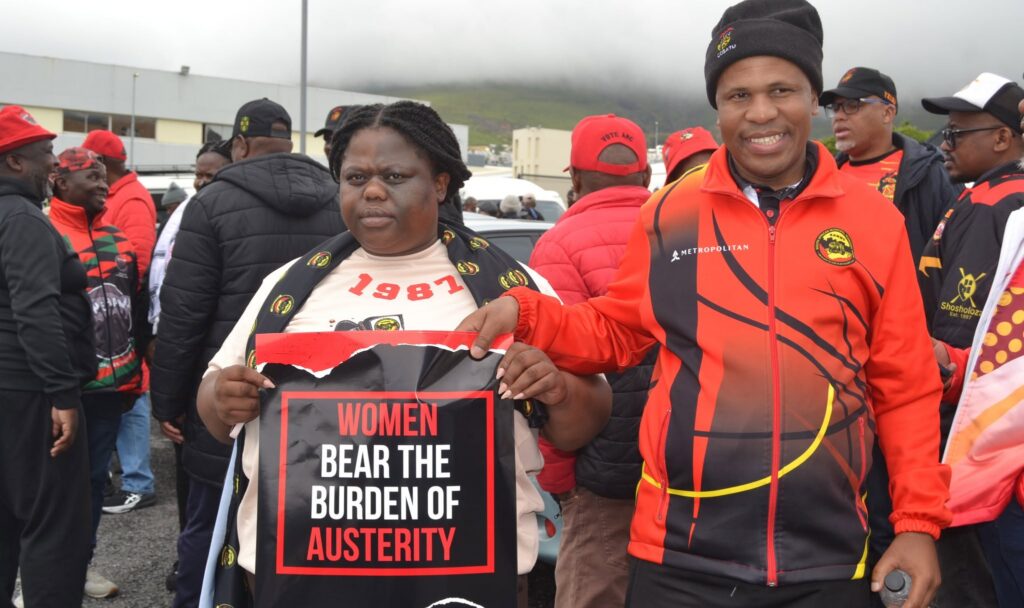
Our point of departure with respect to adaptation starts from the needs of working-class communities. Working with the Cry of the Xcluded, the Amadiba Crisis Committee in Pondoland, Coastal Links on the Wild Coast and community organisations from Botshabelo to Mpumalanga, we have argued for state investment in climate jobs for climate resilience. None of this will be granted from above. Each demand must be organised for, street by street, village by village and workplace by workplace. Its core elements should be:
- A public climate jobs programme for resilience. The state, not the market, must be the employer and investor of first resort. Hundreds of thousands of decent, permanent jobs can be created building and maintaining flood defences and stormwater systems, restoring wetlands, catchments and coastlines, clearing alien vegetation and fighting fires. These would be real jobs at decent wages, not the short-term stipends of a stingy and corrupted EPWP.
- Mass housing as the engine of green industrialisation. Millions of South Africans live in homes that are death traps in heatwaves and floods. A mass programme of well-insulated, climate-resilient public housing, built away from floodplains, would protect lives directly. Sourcing cement, steel, bricks, windows and solar water heaters locally would also give the steel mills of the Vaal and the factories of Gqeberha and Ekurhuleni a market. This is the heart of a needs-based green industrial policy: produce what people need, here.
- Water security as a public good. Drought-proofing our towns means fixing leaking municipal infrastructure, rainwater harvesting, protecting catchments and guaranteeing a free basic supply. It must not mean privatisation, prepaid meters or tariffs that punish the poor.
- Protecting livelihoods on the land and at sea. Small farmers, fishers and rural communities need support for climate-resilient agroecology, seed banks, local food systems and secure rights to land and marine resources. As the Amadiba community has shown in its resistance to mining, communities defending their land are often the first line of adaptation.
- Social protection against climate shocks. A universal basic income guarantee, starting with making the SRD grant permanent and raising it, is a climate adaptation measure. It gives households a floor when floods, droughts and price shocks hit. So do heat-safety protections for outdoor workers and public cooling centres in our townships.
- Community control. Adaptation plans must be made with communities, not imposed on them. Participatory planning, with resources for community organisations to research and monitor their own conditions, is the guard against “resilience” becoming a pretext for forced removals.
- Finance that does not deepen debt. Adaptation must be financed through public finance, not loans. That means reparations from the historic polluters, as well as windfall taxes on fossil fuel profits like BP’s and SASOL’s war bonanza, from the progressive taxation of wealth at home. It means cancelling the debts that force our governments into austerity and ending illicit financial flows that drain the continent of far more than it receives in climate finance.
What to expect from Antalya, and what to do
So, what can climate and social justice activists look forward to at COP31? Modest outcomes, at best, from the negotiating rooms. At best, we may see a just transition mechanism without money, a set of adaptation indicators without finance, and voluntary pledges on electrification and renewables. At worst, rich countries will succeed in burying their promise to triple adaptation finance. Meanwhile, the second Global Stocktake will begin, promising another assessment of a failure we already understand.
That does not mean turning our backs on the COP. It remains a site of struggle, where the demands of African and small island states can be amplified and where rich countries can be held to the promises they have made. There are real openings: the fight to defend the tripling of adaptation finance, the effort to give the just transition mechanism resources, and the growing coalition of countries pushing for a fossil fuel roadmap. Activists in Antalya should use the COP as a platform to support these efforts and to expose the betrayal on adaptation finance. They should demand grant-based finance, real money for loss and damage, and reparations rather than loans. But the decisive work is at home, in organising those who bear the brunt of the crisis.
In South Africa, that means building a movement that links the fight against unemployment to the fight against climate breakdown. It means taking the demand for a public climate jobs programme, for climate-resilient housing and for water security to municipalities, provinces and the Treasury. It means uniting retrenched steelworkers, unemployed youth, shack dwellers, farmworkers and fishers around a common programme. And it means confronting the austerity that tells us there is no money, while there is always money for bailouts, for fossil fuel subsidies and for war.
That organising must start where people are. It means community climate committees in townships and villages that map local risks and draw up their own adaptation plans. It means health and safety committees in workplaces demanding protection from extreme heat. It means alliances between unions and community organisations to contest municipal budgets and disaster management plans. And it means turning every disaster response into a demand for permanent resilience upgrading.
If the fossil fuel industry holds such sway over the COP, we cannot wait for it to deliver what our communities need. The crisis is here. The question is no longer only how fast we can cut emissions, but who will be protected as the temperature rises — and who will be left to burn and drown. That is a political choice, and it is one that only an organised mass movement of the working class, built around the fight to adapt and survive, can force.
Brian Ashley is a member of Zabalaza for Socialism, serves on the Amandla! editorial collective and is the co-ordinator of the Alternative Information and Development centre (AIDC).