SAFTU NEC POLITICAL EDUCATION BRIEFING
1. THE SHIFT TO THE HARD RIGHT IN GERMANY IS PART OF A MUCH BIGGER INTERNATIONAL WARNING
The far right Alternative für Deutschland (AfD) has surged in the Saxony-Anhalt state election in Germany. We should not read this as an isolated German development. It belongs to a much wider international political shift.
Across Europe, the United States, Australia, India, Latin America – and African countries such as South Africa, Kenya, Rwanda and Swaziland – different forms of nationalist, authoritarian, radical-right and in some cases fascist politics are advancing.
These movements differ from one another. They emerge from different histories, cultures and social conditions, and they cannot be collapsed into a single political category. But they do arise within a common international crisis and share many common features.
Decades of neoliberal capitalism have produced vast concentrations of wealth alongside deindustrialisation, weakened trade unions, precarious employment, housing crises, austerity and widespread distrust of established political institutions. At the same time the public sphere has shifted its centre of gravity to social media, where fake news, crude scapegoating and demagoguery have been normalised. All this has been defended by a resurgent imperialism, largely driven by the United States, that has sought to crush challenges to neoliberal capitalism from the left.
Although the global financial crisis of 2008 shattered confidence in the existing economic order, it did not produce the socialist transformation many on the left anticipated. Instead, in significant parts of the world, the right has proved more successful than the left at organising the anger produced by capitalism’s crises. The central strategy of the right to defend neoliberal capitalism has been to incite and normalise racism and to misdirect popular anger against migrants and other vulnerable minorities.
That is precisely what has happened in the recent state election in Germany.
2. THE RIGHTWARD SHIFT ACROSS EUROPE
Across Europe, far-right and radical-right parties have moved from the political margins into parliaments, governments and serious contention for national power. Approximately one in four European voters now supports parties classified as far right.
Austria’s FPÖ became the largest party in its 2024 national election. France’s National Rally has established itself as one of the country’s dominant political forces. Portugal’s Chega has grown rapidly. Italy is governed by Giorgia Meloni’s Brothers of Italy. Germany’s AfD doubled its federal vote to 20.8% in 2025 and has now broken through in Saxony-Anhalt. In the United Kingdom Nigel Farage of Reform UK could well be the next Prime Minister.
Traditional social-democratic parties have lost large parts of their historic working-class constituencies. Mainstream conservative and liberal parties increasingly borrow the language of the radical right on migration in an attempt to recover voters, frequently helping instead to normalise the terrain on which the radical right thrives. Pandering to the right has only strengthened the right.
Building political opposition to migration has become the principal vehicle for the far right through which economic and social insecurity is converted into forms of nationalist politics that give political cover to neoliberal capitalism and the social devastation it causes.
The worker suffering from insecure employment and collapsing forms of social support – including health care, housing, etc – is encouraged to extend anger downwards towards the migrant rather than upwards towards concentrations of economic power.
3. TRUMP: ‘AMERICA FIRST’ — BUT WHICH AMERICANS FIRST?
The same contradiction appears in Donald Trump’s United States. Trump’s political message draws its power from presenting itself as a popular rebellion against the establishment while in fact helping that establishment develop ever more rapacious and socially devastating forms of capitalist extremism.
His use of slogans such as ‘America First’, ‘Bring back manufacturing’ and ‘Protect American workers’ has resonated widely with workers whose lives are worsening to the point that life expectancy for the working class is in rapid decline.
But a working-class movement must ask the critical class question: Which America comes first?
Trump has combined aggressive nationalism, tariffs and immigration enforcement with an economic programme strongly favourable to sections of corporate America and the wealthy. He is in fact the president of the billionaire class, presiding over growing social devastation for the working class, and sections of the middle class too.
His tax-and-spending programme extended huge tax cuts while cutting deeply into Medicaid and food assistance. At the same time, some of the world’s richest individuals – people like Elon Musk – and most powerful corporations – including Tesla, Meta and Amazon among others – have sat unusually close to political power. He is also the most corrupt president in US history. Last year he personally enriched himself by $2.2bn.
This reveals a central contradiction of contemporary right-wing populism. In reality ‘America First’ means oligarchs first. And when workers’ lives continue to worsen the attacks on migrants and other vulnerable minorities are ramped up and attempts are also made to distract workers from the real causes of their suffering with new foreign wars.
4. LATIN AMERICA: THE REVERSAL OF THE ‘PINK TIDE’
The rapid move to the far right is not confined to Europe and North America. Latin America has also undergone a dramatic political reversal. Only a few years ago commentators spoke confidently of a renewed ‘pink tide’ as left and centre-left governments came to power across much of the region. In recent years the left has been beaten back across Latin America.
Far right, right and centre-right candidates have won a succession of presidential contests, including elections that removed governments or movements of the left and centre-left from power.
Argentina’s buffoonish Javier Milei became an international symbol of radical free-market politics. Other countries have subsequently experienced significant movements towards the far right, including Ecuador, Bolivia, Honduras, Chile, Costa Rica, Peru and Colombia.
We should not conclude that Latin America’s working classes have permanently converted to right-wing politics but the political lesson is unmistakable: the right does not surrender in the face of the left, and the rich always have real power. Left governments can only effectively defend themselves when they sustain the support of the bulk of the working class.
When governments of the left fail to transform people’s material circumstances — where corruption persists, economies stagnate, inequality remains, crime expands and ordinary people conclude that their lives have not fundamentally improved — social and political disappointment does not necessarily produce more radical left politics.
It can produce precisely the opposite. Workers who voted left yesterday can vote right tomorrow. The international left must therefore abandon the comforting assumption that history automatically moves in our direction. There are countries, such as India, where the right is so entrenched that it has fundamentally reshaped society in ways that will be very difficult to undo.
5. ONE CAPITALIST CRISIS — COMPETING POLITICAL ANSWERS
From Trump’s United States to Europe, India and Latin America, the political right has learned how to take genuine grievances produced by the existing economic order and give them nationalist, anti-establishment or authoritarian interpretations.
The language differs from country to country. We have heard the American version. Elsewhere it is Germany First, take back our country, restore national greatness, remove the foreigners, protect our culture, find the Messiah who will rescue the nation.
These slogans speak powerfully to people who feel humiliated, abandoned and economically insecure. But they leave the class questions unanswered. Who owns the economy? Who controls investment? Who receives the profits? Why does great private wealth coexist with poverty? Why are workers required to carry the costs of every capitalist crisis? Why are billionaires becoming richer while workers are told that migrants are responsible for their declining living standards?
This is the ideological battlefield on which much of the contemporary international left is losing ground.
6. THE UKRAINE WAR, RUSSIA AND THE POLITICAL COST OF EUROPE’S ENERGY BREAK
Another indispensable part of the German and European story is the war in Ukraine.
Russia launched its full-scale invasion of Ukraine on 24 February 2022. Europe, and Germany in particular, made a historic geopolitical choice. Germany abandoned decades of policy built partly around economic integration with Russia, supported successive rounds of sanctions against Moscow, backed Ukraine financially and militarily, increased defence expenditure and committed itself firmly to the NATO and European position that Russia’s invasion constituted aggression that had to be resisted.
This was a major strategic rupture. Before the war, German industry relied substantially on Russian pipeline gas, which was generally cheaper and more predictable than many alternative supplies. Germany’s industrial model combined advanced manufacturing, exports and relatively inexpensive energy. The war and the subsequent collapse of much of the previous energy relationship with Russia disrupted that model.
Russia reduced gas supplies to Europe, the Nord Stream pipelines ceased to function as the basis of German-Russian energy relations, European governments imposed sanctions and Germany sought alternative sources of gas. Germany avoided the most severe shortages that many initially feared, partly through emergency measures, reduced demand, expanded imports and the rapid construction of LNG infrastructure.
But the adjustment was costly.
The consequences were higher energy costs and higher inflation, pressure on household purchasing power, higher production costs for energy-intensive industries, and growing anxiety about industrial competitiveness, employment and Germany’s economic future.
The war did not create all of Germany’s economic problems. Germany’s difficulties also involve long-term underinvestment, slowing productivity, competition from China, demographic pressures, restrictive fiscal policy and structural changes in global manufacturing. Nor was every increase in energy prices caused by sanctions against Russia. Global demand, supply constraints, energy-market structures and government policy also mattered. The war, and the rupture of the energy relationship with Russia, intensified economic problems that already existed.
After more than four years of war, many Germans are asking what this confrontation has cost them. It is an explosive question.
7. THE AfD’S ANSWER: END SUPPORT FOR UKRAINE AND REOPEN THE DOOR TO RUSSIA
The AfD has positioned itself sharply against the foreign-policy consensus established by Germany’s mainstream parties. Senior AfD politicians have argued that Germany damaged its own industry by abandoning cheap Russian energy and supporting sanctions. The party opposes Germany’s continuing military support for Ukraine and has called for sanctions against Russia to be removed. It supports rebuilding German-Russian economic relations and restoring Russian energy supplies.
This message has particular resonance in eastern Germany. Parts of the former German Democratic Republic have a different historical relationship with Russia from western Germany. Many older East Germans lived alongside Soviet forces. There is also resentment towards western German political elites and, among some voters, nostalgia for aspects of the earlier economic relationship with Russia.
But this history alone does not explain AfD support. Economic insecurity, the effective scapegoating of migrants, distrust of established parties and regional political culture also matter.
The AfD is nevertheless organising popular discontent around a question many workers may find understandable: Why should German workers bear the economic costs of a war they did not choose?
8. “ANTI-WAR” DOES NOT AUTOMATICALLY MEAN LEFT-WING OR ANTI-IMPERIALIST
The AfD presents its position partly through the language of peace, demanding that Germany stop sending weapons, remove sanctions, restore economic relations with Russia and end the war. But its commitment to peace is not sincere. It has supported Israel and endorsed the 28 February 2026 Israel-U.S. attack on Iran that killed the country’s leader Ali Khamenei, more than 40 senior officials and 160 school children.
The socialist position must be for genuine peace, just peace. We must criticise NATO, which is a military instrument of Western power rooted in the colonial order. It incorporated authoritarian and fascist allies, supported Portugal’s colonial wars in Africa, constrained left-wing political alternatives, and later extended US-led military and neoliberal dominance beyond Europe. It is necessary for the left to oppose militarisation, sanctions, weapons supplies and the strategic failures that preceded and prolonged this war, as well as the wider project of Western imperialism. It was inexcusable for the Western imperialist powers to violate early-1990s promises made by their leaders to Russian rulers, about not expanding NATO boundaries eastward beyond the enlarged German border.
But that does not require denying the basic fact that Russia invaded Ukraine. Nor does opposition to NATO automatically make Vladimir Putin’s Russia progressive. Today’s Russian state is not the Soviet Union. It is a corrupt and authoritarian capitalist state, marked by vast concentrations of wealth and political power and by business interests intertwined with the state.
There is no sense in rejecting Western oligarchic power only to romanticise Russian oligarchic power. The socialist position cannot be: Washington oligarchs bad, Moscow oligarchs good. Socialists must critique NATO, Western imperialism and Putin’s regime. We must always hold to political principle.
Our question must remain: What are the interests of Russian workers, Ukrainian workers, German workers and workers everywhere?
9. DOES THE AfD HAVE LINKS WITH RUSSIAN INTERESTS?
It would be inaccurate to claim that every AfD leader is an agent of Russia, that the party is controlled by Moscow or that it simply represents Russian oligarchs. There have, however, been serious investigations and allegations concerning individual AfD politicians and alleged Russian influence networks.
In 2024, AfD politician Petr Bystron faced allegations concerning money associated with the pro-Russian Voice of Europe network. German authorities searched properties linked to him during investigations into suspected bribery and money laundering. He denied wrongdoing. Other AfD figures have faced scrutiny over alleged Russian influence or payments. No court has ruled on any of this, and allegations are not findings.
The more important political point is already visible in the AfD’s declared programme. It advocates policies favourable to Russia’s economic and geopolitical interests, and to those already set out above it adds the weakening of the European consensus against Russia.
That does not prove Moscow controls the AfD. But it does mean that describing the AfD simply as an “anti-war party” is inadequate. It is more accurately understood as a racist, xenophobic and nationalist German party whose foreign-policy programme strongly favours restoring relations with Putin’s Russia.
10. WAR, REARMAMENT AND THE CRISIS OF THE EUROPEAN LEFT
The Ukraine war has also divided progressive politics throughout Europe. Some sections of the left have prioritised solidarity with Ukraine against Russian aggression. Others have prioritised opposition to NATO, militarisation and Western intervention. Others have attempted to hold both positions simultaneously and condemned Russia’s invasion while opposing endless military escalation and demanding negotiations.
Meanwhile, European governments have dramatically increased military expenditure. Germany’s Zeitenwende — historic turning point — has involved large-scale rearmament and a fundamental shift in security policy. This inevitably raises an urgent question for the working class: If governments can suddenly mobilise vast resources for weapons and rearmament, why were workers repeatedly told that there was insufficient money for housing, healthcare, infrastructure and social protection?
That contradiction creates fertile political territory but significant parts of the anger generated by it are currently being captured not by the socialist left but by the racist and xenophobic nationalist far right.
11. ENERGY, MIGRATION AND THE POLITICS OF MISDIRECTED ANGER
This is where different crises become politically connected. Migrants, often fleeing wars in which European powers are implicated, did not cause the energy rupture. They did not impose the sanctions against Russia that damaged the German economy. Refugees did not decide German military expenditure. Asylum seekers did not destroy the Nord Stream pipeline, which was blown up in September 2022. German prosecutors have arrested and charged Ukrainian suspects.
Yet the far right connects these separate crises into one apparently coherent political story: Your factory is closing, your electricity is expensive and your government sends billions abroad. It spends billions supporting Ukraine, sanctions Russian energy, accepts refugees and takes instructions from Brussels. And then it tells you there is insufficient money for your pension or public services. Much of this story is just not correct but politically it can feel coherent to a worker experiencing insecurity.
The worker is made to carry some of the economic consequences of geopolitical conflict through energy prices, inflation and industrial insecurity. Then that worker is encouraged to blame another victim of global instability — the migrant. The real causes are displaced from war, geopolitical competition, energy markets, corporate pricing, austerity, underinvestment and decisions made by governments and corporations to people possessing the least economic and political power – migrants and refugees.
The socialist task is never to deny workers’ hardship. It is always to explain it correctly.
12. SAXONY-ANHALT: THE FIGURE THAT SHOULD FRIGHTEN THE LABOUR MOVEMENT
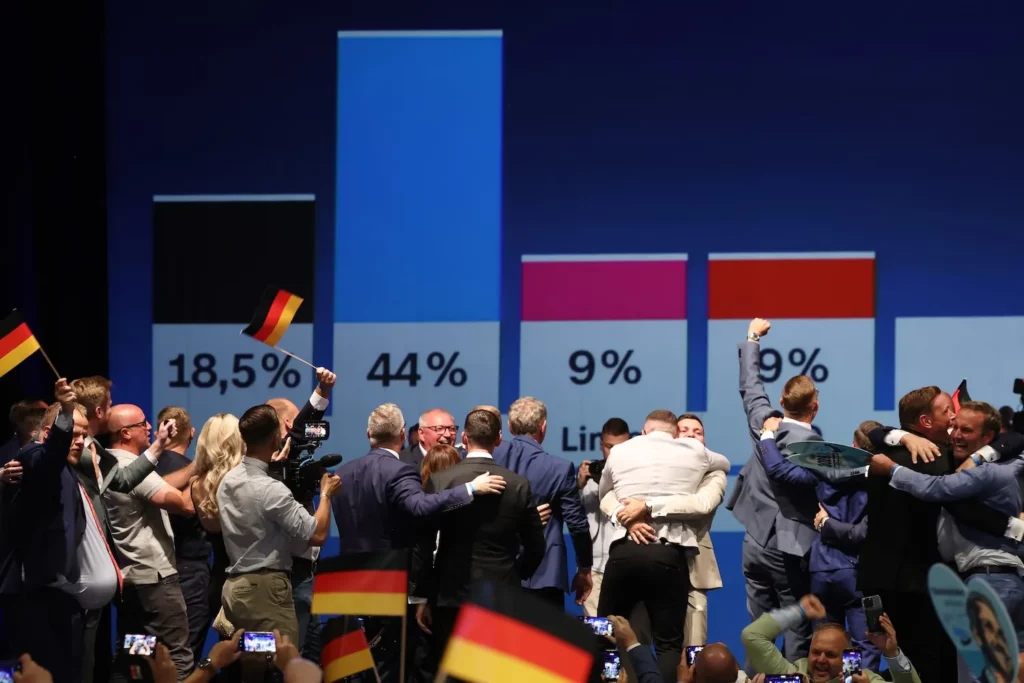
Against this international background, the Saxony-Anhalt election of 6 September 2026 matters far beyond Germany. The AfD won 43.8% of the party vote, securing 39 of the 83 seats in the state parliament. But for trade unionists the most frightening figure is that approximately 61% of workers voted AfD. A party widely classified as far right has become the dominant political choice of workers in one of Germany’s poorer eastern states.
Trump has shown that nationalist politics can mobilise workers while leaving great concentrations of wealth untouched. In Latin America, voters who elected left governments a few years ago have swung to the right. In Europe the radical right has moved from the margins towards the centre of political life, and in India it has entrenched itself deeply enough to reshape the structure of society.
Saxony-Anhalt shows something more disturbing still: the far right can become the dominant political force among workers themselves.
13. WHAT EXACTLY IS THE AfD?
The Alternative für Deutschland (Alternative for Germany) was founded in 2013, in the aftermath of the global financial crisis and European sovereign-debt crisis. It did not begin primarily as an anti-immigrant movement. Its founders included economists, academics, businesspeople and conservative intellectuals opposed to European financial bailouts and deeply critical of the euro. Its original orientation was principally economically liberal, conservative and Eurosceptic. But the party subsequently underwent a profound transformation.
From around 2014 onwards, its centre of gravity moved towards German nationalism, racism, anti-Muslim politics and increasingly radical conceptions of German national identity.
The refugee crisis of 2015 was decisive. Moderate conservative founders progressively lost control or left and more radically right-wing nationalist forces became dominant.
The AfD entered the Bundestag in 2017. In the 2025 federal election it won 20.8% nationally, becoming Germany’s second-largest parliamentary force. Now, in Saxony-Anhalt, it has reached nearly 44%.
None of this happened overnight. It took more than a decade of consolidation and radicalisation. Far right projects are built over years, sometimes decades, before they appear to erupt.
14. WHY IS THE AfD REGARDED AS FAR RIGHT?
The term far right must not become merely an insult applied to everyone with whom the left disagrees. We must be clear about its meaning, as we must with the term fascism, which is often used to describe the ruling party in India and many smaller groups elsewhere in the world.
Prior to the rise of the AfD Germany already had a mainstream conservative political tradition represented principally by the CDU/CSU. The AfD goes considerably further. Its politics combine assertive nationalism, hostility to immigration and multiculturalism, cultural conservatism, Euroscepticism and an exclusionary conception of German belonging.
Its politics increasingly divide society between those regarded as legitimately belonging to the national community and those presented as outsiders. Some sections of the party have gone as far as promoting “remigration”, the idea that legally documented migrants and refugees must be forcibly sent back to their countries of origin.
It is this combination of ethnonationalism, racism, anti-immigration politics and authoritarian cultural nationalism that places it on the radical or far right.
15. WHO DOES THE AfD REPRESENT IN CLASS TERMS?
This question is crucial because who votes for a party and whose economic interests its programme advances are not necessarily the same thing. In fact with the far right they are always opposed.
The AfD did not originate in the organised labour movement. It emerged from middle-class, professional, academic and business circles, and from economically liberal conservatism. Yet it now draws mass working-class support.
Its economic philosophy does not fundamentally challenge capitalist ownership. It does not seek worker control over production. It does not propose social ownership of the commanding heights of the economy. Instead, much of its economic programme emphasises lower taxation, deregulation, national competitiveness, cheaper energy and German economic sovereignty.
This produces one of the great contradictions of contemporary European politics: The AfD has won a mass working-class electorate without becoming a workers’ party in the class-programmatic sense.
16. THE AfD CHANGES THE IDENTITY THROUGH WHICH WORKERS UNDERSTAND THEIR CRISIS
The socialist movement says you are a worker, your interests unite you with other workers, your exploitation arises from your relationship with capital and your power lies in organisation and solidarity.
The nationalist right says you are first a German, your country is being taken away, your government cares more about migrants than about you, your taxes support outsiders, your national identity is disappearing, political elites have betrayed Germany and your power lies with exclusionary nationalism.
When this is accepted the worker’s political identity shifts from class to nation, from worker versus capitalist, to German versus foreigner, from international solidarity to nationalist chauvinism.
The far right works to redirect rather than abolish working-class anger.
17. THE MIGRANT BECOMES THE VISIBLE FACE OF AN INVISIBLE ECONOMIC CRISIS
Capital, financialisation, global supply chains and industrial restructuring are hard to see. But a migrant standing alongside a worker in a queue for employment, housing or public services is very easy to see. This makes migrants convenient political scapegoats.
There is a particularly painful dimension to this for us as Africans. Across Europe xenophobia is entangled with racism, and is often an expression of racism. Among those caught in Europe’s increasingly hostile migration politics are African and Black migrants — people crossing deserts and the Mediterranean, fleeing poverty, unemployment, war, authoritarianism and societies offering them little hope.
Many are, in a profound historical sense, running away from the failed African revolutions — liberation struggles that promised freedom and dignity but whose post-colonial states too often failed to deliver industrialisation, employment, democracy and a decent life. They reach Europe only to become political scapegoats for a capitalist crisis they did not create. The African worker who could not find a future at home becomes the migrant in Europe blamed for the European worker’s insecurity.
Two victims of the same global system are encouraged to see one another as enemies.
18. THERE IS ANOTHER GERMANY: WHAT IS DIE LINKE?
Against this background SAFTU should understand Die Linke, the Left. It was established in 2007 through the coming together of two political traditions. The first was the Party of Democratic Socialism (PDS), whose roots lay in the former ruling Socialist Unity Party of East Germany. The second was the WASG, the Electoral Alternative for Labour and Social Justice, which brought together western German trade unionists, socialists, former social democrats and activists who rebelled against the neoliberal labour-market and welfare reforms associated with Agenda 2010.
Die Linke therefore brought together an eastern post-socialist tradition and a western revolt against neoliberalism.
19. WHAT DOES DIE LINKE STAND FOR?
Where the AfD places its emphasis on immigration, sovereignty and German national interests, Die Linke emphasises class inequality and the concentration of economic power.
Its programme advocates higher taxation of great wealth and of inheritance, higher wages, stronger trade-union and worker rights, affordable housing, expanded social security and public services, public investment, ecological transformation whose costs are not dumped on workers, opposition to militarisation, and protection of migrants and refugees against racism and scapegoating. Its 2025 federal programme declares: ‘Capitalism must not have the last word in history.’
This makes the Saxony-Anhalt result particularly instructive. It shows that having a left programme is not enough. The left must actually win workers politically.
20. DIE LINKE, ROSA LUXEMBURG STIFTUNG AND SAFTU
All this is particularly relevant because of SAFTU’s special relationship with the Rosa Luxemburg Stiftung. The Foundation is closely associated with Die Linke but institutionally independent. Its political tradition is democratic socialist, internationalist, anti-fascist and anti-racist. Our relationship therefore carries more than programmes or resources.
There is an intellectual and political tradition behind the name Rosa Luxemburg that our movement should understand.
21. WHAT DID ROSA LUXEMBURG STAND FOR?
Rosa Luxemburg became one of the outstanding revolutionary Marxists and socialist intellectuals of the German and international labour movement. She fought capitalism, imperialism, colonialism, militarism and war with rare clarity and courage, and gave her life for the socialist cause. She was murdered in 1919 by a right-wing paramilitary group.
When Europe descended into the First World War, German workers were mobilised to kill French workers and French workers to kill German workers. Workers sharing fundamental class interests slaughtered one another while Europe’s ruling classes pursued imperial ambitions. Luxemburg insisted that workers had more in common with workers across national boundaries than with the capitalist classes ruling their respective countries and regarded the capitulation of large sections of social democracy to nationalism and war as an historic betrayal.
Her internationalism arose directly from her understanding of class. Her analysis speaks directly to our own moment, when Russian and Ukrainian workers are again dying in war while European workers carry economic costs and nationalism grows across the continent.
22. ROSA LUXEMBURG VERSUS MESSIAH POLITICS
Luxemburg also insisted that socialism could not simply be handed down to workers from above. Workers themselves had to become conscious actors in their own liberation. This resonates directly with the principle of worker control that has guided the trade union movement in South Africa since the Durban strikes in 1973, and which remains a central principle for SAFTU.
Her key political idea was that workers cannot be liberated by somebody else acting on their behalf: they must become the conscious agents of their own emancipation.
This clashes fundamentally with ‘Messiah’ politics.
The Messiah figure says ‘Only I can save you’ with the result that the organisation and its programme become secondary. Internal democracy is repressed and criticism of the leader treated as betrayal. Political loyalty attaches to a personality rather than to principles and programme. This can be seen in trade unions as well as political parties.
For Luxemburg the working class is the author of its own emancipation, not a following in search of a saviour.
23. THE CENTRAL LESSON FOR THE EUROPEAN LEFT
Simply denouncing AfD voters as racist, fascist, stupid or backward will not defeat the AfD. It will only deepen their alienation and anger.
The left must confront the material conditions from which the right draws its strength. Workers worried about factories closing need an industrial alternative. Workers worried about wages need bargaining power. Communities worried about deteriorating services need functioning public institutions. Young people need jobs, housing and hope. Workers angry about war and rearmament need a credible politics of peace that neither excuses Russian aggression nor becomes an appendage of NATO. Questions about migration must be addressed rationally and democratically without converting migrants into scapegoats.
If the left does not recognise the suffering of the working class and offer real solutions to its problems the radical right will be able to continue telling workers that it understands their suffering while the establishment does not. When the socialist left ceases to provide a convincing class explanation of society, nationalism will provide another explanation.
24. A SHORT BUT URGENT WARNING FOR SAFTU
South Africa is not Germany and we should not mechanically equate South African political movements with the AfD. Nonetheless, the political mechanism revealed in Germany should concern us deeply.
A key lesson is that the working class does not automatically move left when capitalism enters crisis. Economic suffering does not automatically produce socialist consciousness.
In times of crisis workers can move right, choose nationalism over socialism and become xenophobic and Afrophobic. They can also become tribalist and regionalist, retreating into narrow identities of ethnicity, language, province and place of birth instead of recognising common class interests.
Workers can be persuaded that another poor worker — a migrant, somebody from another province, another ethnic community or another nationality — is responsible for their suffering. They can abandon democratic organisations and accountable collective leadership for Messiah figures who promise that they alone can rescue the nation or community.
Politics shifts from questions of programme, class interests, ownership, wealth and democratic accountability to questions of identity and belonging: who leads us, who is one of ‘us’, and who will protect ‘us’ from ‘them’. Once this happens class politics is defeated.
25. A WORKER CAN BE MILITANT AND STILL MOVE TO THE RIGHT
It is essential that we all understand that:
- A worker can be militant against an employer and still be politically conservative.
- A worker can understand exploitation inside the workplace and embrace xenophobia outside it.
- A worker can demand worker control inside a union while surrendering political judgement to a Messiah figure outside the union.
- A worker can proclaim working-class unity while embracing tribalism, regionalism or hostility towards African migrants.
There is nothing automatic about class consciousness. It must be built, educated, organised and defended.
This is why worker political education is always central to class struggle itself.
26. THE SOCIALIST RESPONSE CANNOT BE CAMPISM
The lesson from the Ukraine war must also be carried into our broader international politics. Workers should not be required to choose between Washington and Moscow, NATO and Russian oligarchs or European militarism and Russian nationalism.
A socialist position must begin from the independent interests of workers. This means that it must condemn NATO’s expansion, Russia’s invasion of Ukraine and the brutal slaughter of both Russian and Ukrainian workers.
It must reject the idea that criticism of NATO requires treating Putin’s Russia as progressive. We can and must be critical of both NATO and Putin. We must insist that negotiations, peace and self-determination are working-class interests. As socialists we must demand an end to the war, reject imperialism from every direction, protect workers from its economic costs, defend migrants and refugees as fellow workers, and rebuild an international working-class politics independent of all oligarchies.
27. THE BATTLE FOR THE POLITICAL SOUL OF THE WORKING CLASS
The struggle of the working class, and the struggle for socialism, is not simply to organise workers into unions. It is to organise workers into a conscious class — a class that understands who benefits from its exploitation, refuses to turn other victims into enemies, rejects xenophobia, tribalism and regionalism, will not surrender itself to political Messiahs, sees through the false choice between competing oligarchies, and recognises that an injury to one remains an injury to all.
This is our task in the current crisis. We need to build democratic socialist unions and a powerful movement that, working with other democratic forces, can anchor a wider democratic socialist project. We only have to look to New York, where Zohran Mamdani, a democratic socialist, is now the mayor, to see what can be achieved even under extremely difficult circumstances.