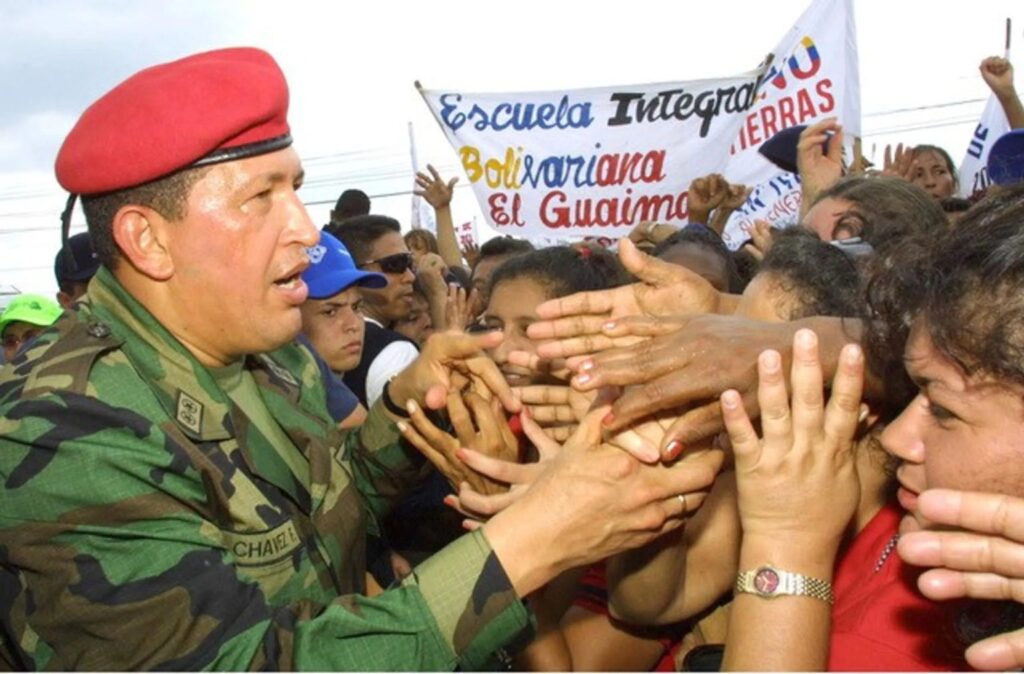
Eyewitness to the failed 2002 coup against Hugo Chávez and the popular fightback it provoked
Callum Joyce, Socialist Party National Committee
On 11 April 2002, Venezuelan president Hugo Chávez was arrested and removed from power by leading figures in the Venezuelan military with the backing of big business, the private media, and religious leaders. The reforms of the past three years that had been implemented in the interests of the poor began to unravel and the rule of Chávez and his ‘Bolivarian Revolution’ was over.
Then less than 48 hours later, the military coup was aborted, Chávez was back in the presidential palace, and the leaders of the new government were fleeing abroad with their tails between their legs. How this remarkable series of events took place is the subject of this highly interesting 2003 documentary which follows the struggles of that month as they unfolded.
Chávez had been elected in 1998 with a huge landslide in opposition to the neoliberal policies of previous governments. Using the country’s revenue from its position as one of the world’s largest oil exporters, the new regime began to implement reforms that would benefit the peasants and the urban poor who comprised over 80% of the population.
Interviews with Chávez supporters show what the impact of the reforms has been on their outlook: “Politics meant nothing to us. One group got rich while we got nothing. But now we’re really interested in politics, because politics is now about participation and democracy.”
Opposition
But support for the new government is not universal. The right-wing opposition, led mainly by those who benefited under the previous pro-capitalist regimes, decide to take action when Chávez replaces the heads of the crucial state oil company with his own supporters.
The opposition leaders and the lackeys of the ruling class are flown to Washington DC to discuss their concerns with the US government. The motivation behind these discussions is casually made clear by the then-director of the CIA: “Venezuela is important because they’re the third largest supplier of petroleum. I would say Mr. Chávez… probably doesn’t have the interests of the United States at heart.”
Leading Venezuelan military figures are interviewed on national television, warning Chávez to resign or face an ominous threat of ‘action’. In a country with a history of military coups, the meaning could not be any more obvious! The first loyalty of the tops of the military and the state forces is to the status quo and the interests of capitalism – not to any democratically elected president or the wishes of the population.
Huge protests
A huge protest is whipped up outside the state oil company headquarters, but at the last minute they decide to march on the presidential palace instead. As they arrive they meet a rally of Chávez supporters and tensions quickly reach boiling point. The documentary footage captures the awful moments as shots ring out and a number of Chávez supporters are shot through the head by sniper fire. Some inevitably return fire – in Venezuela a quarter of people carry handguns – and a shootout ensues between small sections of the opposing crowds.
The military leaders capitalise on the chaos and swiftly intervene as they had always planned – a fact which they happily admitted to in television interviews afterwards! Troops surround the presidential palace and demand that Chávez resign or the tanks will open fire.
Chávez is arrested and the reins of government are handed to the opposition. It all appears to be over, but one Chávez supporter foreshadows what the military and capitalist leaders have failed to anticipate – the reaction of the masses: “Wait and see, tomorrow there’ll be a bloodbath in Caracas [Venezuela’s capital]. People aren’t going to stand for this.”
The following day the media begins spreading the story that Chávez has willingly agreed to resign. Pedro Carmona, head of Fedecámaras – the main federation of big business in Venezuela – is sworn in as the new president. The National Assembly and the Supreme Court are dissolved. Numerous speeches about the return of freedom and democracy are made, interspersed with footage of brutal police repression and live rounds fired at Chávez supporters in the street.
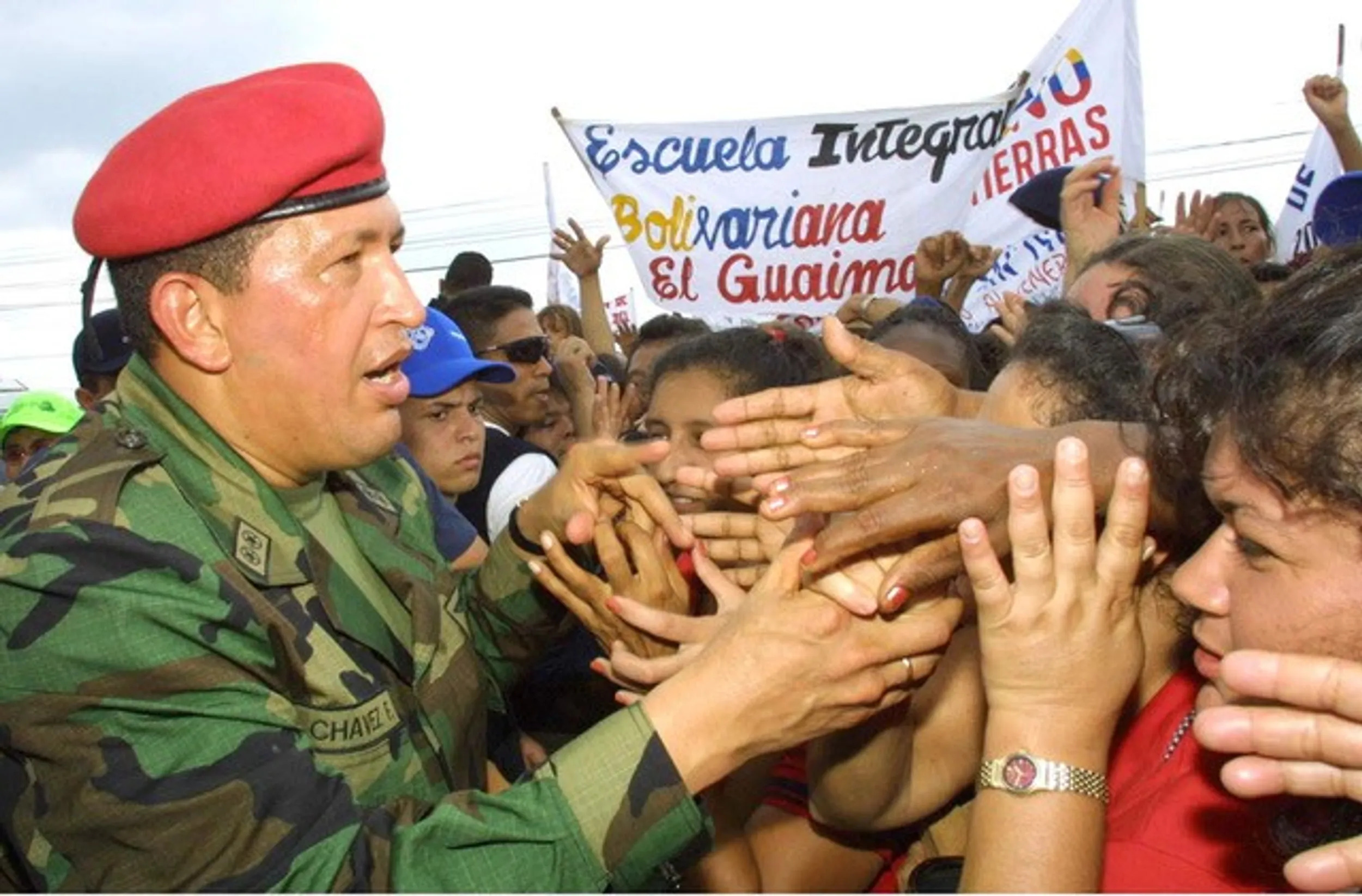
Despite deception by the media, news slowly begins to spread that Chávez has not resigned, but is being held prisoner. The new government is not legitimate. More importantly, the reforms that have begun to lift some of the weight of grinding poverty are in danger. The ‘whip of counter-revolution’ spurs the masses out onto the streets once more – chants of “Chávez, the people are with you!” ring out as tens of thousands march on the presidential palace.
Protesting masses
The leaders of the interim government and the generals hole up, protected by the presidential guard. But they are oblivious to the processes taking place, even in their own state forces. All of a sudden they are surrounded as the presidential guard proclaims its loyalty to Chávez and seizes the presidential palace, to great cheers from the protesting masses outside. Messages of support from troops and low-ranking officers around the country flood in to protest how they have been lied to by their leaders.
The coup plotters just manage to escape, but it’s clear the game is up. Any attempt now to deploy the military against the movement would see it split apart in their hands. Grudgingly, they are forced to return Chávez to the jubilant crowds: “He’s back! He’s back!” The ‘all-powerful’ state apparatus and the ruling capitalist class behind it are paralysed before the might of the masses.
But in his first speech Chávez calls for calm. The protesters are encouraged to return home and Chávez later promises there will be no ‘witch-hunt’ against those involved in the coup. The machinery of the capitalist state is left in one piece and the Venezuelan ruling class – which, despite the important reforms carried out, is still in control of the decisive levers of the economy – is left to regroup and plot its revenge.
No clear programme
There is no doubting the genuine intentions of Chávez and the genuine support of the poor for his reforms, including their willingness to go out and fight for them, as shown in this documentary. But without a clear programme to dismantle the profit-driven anarchy of capitalism and a clear perspective for what type of struggle is needed to break the resistance of the ruling class, those reforms can only be temporary and will always be under threat.
Absent from the events in Venezuela in 2002 is any party explaining the need for such a programme and organising to fight for it. The situation in the country today, with the collapse of the economy, millions having left the country, and the unravelling of many of Chávez’s reforms, is a graphic demonstration of the consequences.
Anyone seeking to understand the situation in Venezuela today will gain valuable insights from this fascinating documentary and be aided in drawing the key lessons about how future struggles to transform society in the interests of workers and the poor can succeed.
- The Revolution Will Not Be Televised is available to watch on YouTube, Vimeo and other online video platforms
The real Chávez legacy
The February edition of Socialism Today reprints an article by Tony Saunois that was first published in the April 2013 edition of Socialism Today, No.167. This was following the death of Hugo Chávez, Maduro’s predecessor, and draws up a balance sheet of the legacy of Chávez and the ‘Bolivarian revolution’. The article warns that despite Chávez implementing reforms to the benefit of the poor masses in Venezuela, unless the revolution were to go further and break with capitalism the way would be paved for a growth in corruption, inefficiency, and economic sabotage and collapse. These processes were greatly intensified and accelerated under Maduro, who sought even more to accommodate with capitalism, resulting in the economy collapsing by a mind blowing 80% during his presidency, fatally undermining the previous economic and social gains of ‘Chavismo’.