
A single sentencing in April 2026 reveals the apartheid logic still running through South Africa’s courts, its water pipes, its power grid, its housing policies, and its hospitals.
I. The Core Argument
The April 2026 sentencing of Julius Malema is not an aberration. It is not the act of a single biased magistrate. It is a symptom—a visible eruption of an invisible structure. That structure is the continuation of apartheid logic through the everyday functioning of South Africa’s state institutions, 32 years after formal democracy.
The magistrate, Twanet Olivier, is not a monster. She is a functionary. She operates within a system of incentives, legal training, economic pressure, and institutional memory that was never fundamentally dismantled. Her judgment against Malema—five years for a symbolic act causing no physical harm—makes perfect sense within that system. The same system produces:
- Water shut-offs for poor Black townships while white farmland receives preferential allocation.
- Endless electricity blackouts while private generators hum in wealthy suburbs.
- Evictions for shack dwellers while property rights for large landowners remain sacred.
- Healthcare queues of 12 hours in public hospitals while private medical schemes offer same-day surgery.
The magistrate’s gavel, the municipal tap, the Eskom grid, the eviction order, the hospital triage list—they are all nodes on the same network. They all follow the same unwritten rule: Black life is cheaper. Black political assertion is dangerous. White capital is normal.
II. The Magistrate and the Judiciary: The Legal Node
The April 2026 ruling sentenced Malema to five years for firing an automatic rifle in 2018. No one was hurt. No property was damaged. The magistrate herself acknowledged the defense’s argument that the gun was “displayed and used for celebratory shots” but rejected it, saying: “We hear daily… of children caught in crossfire… It’s just the first time we hear it being called celebratory shots.”
The political sharpening comes from comparison.
The Coligny case (2017–2020): Two white farmers were convicted of throwing a 16-year-old Black boy from a moving vehicle, killing him. The conviction was overturned entirely by the Supreme Court of Appeal. The court found the State’s key witness unreliable. The men walked free. The NPA declined to appeal further.
The material pattern is clear: A Black political leader is imprisoned for a symbolic act. White men who killed a Black child are freed. The law is not neutral. It is a terrain of struggle whose outcomes are determined by who is standing on it and who owns the ground beneath.
Beyond Malema and Coligny: The broader judicial pattern
- Bail decisions: Black accused are routinely denied bail for non-violent offenses; white accused in fraud cases often receive bail with minimal conditions.
- Sentencing for economic crimes: A Black municipal official stealing R500,000 receives a longer sentence than a white executive who defrauds the state of R50 million through a tendering scheme.
- Private prosecutions: AfriForum has successfully prosecuted Black political figures (Malema, Zuma) but has never brought a comparable case against a white political or economic figure. The NPA, underfunded and politically compromised, often defers to or collaborates with these private actors.
The cost of appeal is the final lock on the door. To appeal a criminal conviction in South Africa requires legal fees that can reach R1 million. For an unemployed shack dweller in Khayelitsha, an adverse ruling is final. For a white farmer with access to agricultural union legal funds, the Supreme Court of Appeal is a realistic option. The millions who lack that access are simply consumed by the system and never counted.
The judiciary does not produce injustice by accident. It produces it by design—the design of who can afford to participate, who is presumed credible, and whose life is treated as worthy of protection.
III. Water: The Most Basic Human Right, Privatized by Pattern
Access to water in South Africa follows the same logic as access to justice.
The legal framework: Section 27 of the Constitution guarantees everyone the right to access sufficient water. The Free Basic Water policy promises 6,000 liters per household per month free.
The reality: In poor Black townships and rural former homelands, water is often intermittent (hours per day, or days per week), contaminated (sewage leaks into supply), and expensive (prepaid meters cut off automatically when credit runs out). In white suburbs and wealthy enclaves, water is constant, high-quality, and structured to favor high-volume users.
The structural mechanism: Water is managed by municipalities and, increasingly, by private concessionaires (Suez, Veolia, local contractors). These entities have a financial interest in maximizing revenue, not in fulfilling rights. The apartheid-era spatial geography—townships far from reservoirs, white suburbs near the source—was never redrawn. The pipes run the same direction. The water follows the money.
When a poor Black household’s prepaid meter cuts off at midnight because the breadwinner lost a job, no court intervenes. When a community in Makhanda goes weeks without water, no magistrate issues an order. The water department official who approves a new connection for a white-owned farm in the drought-stricken Karoo faces no sanction. The system allocates water by race and class as surely as apartheid’s 1956 Natives (Urban Areas) Act allocated residential permits.
The same logic that criminalizes Malema for “reckless” political speech also criminalizes a shack dweller for “illegally” connecting a pipe to a municipal main. Both are acts of survival—political survival for Malema, physical survival for the shack dweller. Both are met with state force. Both protect the same underlying interest: the existing distribution of resources must not be disturbed.
IV. Energy: Load-Shedding as a Class Weapon
Eskom’s inability to provide reliable electricity is not a technical failure. It is a political and economic outcome of a deliberate structure.
The history: Under apartheid, electricity was heavily subsidized for white industry and white homes. The townships received the poorest infrastructure. After 1994, instead of a fundamental restructuring, the state pursued independent power producers (IPPs)—mostly controlled by white-owned capital—while the coal fleet was never properly maintained because maintenance contracts went to politically connected tenderers, not to competent engineers. The pricing structure shifted costs onto poor households while protecting large industrial users (mining houses, smelters) that are still largely white-owned.
The lived experience: In Soweto, residents face load-shedding for 8–12 hours per day. In Sandton, generators hum behind electric fences. The wealthy buy their way out of the crisis. The poor absorb it.
The hidden transfer: The diesel for Eskom’s open-cycle gas turbines costs billions of rand per year. That money comes from the fiscus—from taxes paid by working people. It flows to foreign diesel suppliers and local logistics companies. The working class pays for the failure of a system they do not control, to keep the lights on for the class that owns the economy.
When Malema says the EFF will “take over” land and mines, he is criminalized for incitement. When a white-owned business installs a diesel generator to bypass load-shedding, that is called “resilience.” The same act—refusing to accept the system’s failure—is treated as a crime when done by a Black political leader and as a virtue when done by a white capitalist.
Energy, like water, is not distributed by technical logic. It is distributed by power. And power in South Africa still lives where apartheid put it.
V. Shelter: Housing, Evictions, and the Sacred Right of Property
The Constitution guarantees access to adequate housing (Section 26). It also protects property rights (Section 25). These two rights have been in continuous conflict since 1994—and property has almost always won.
The pattern of evictions:
- In wealthy areas (Constantia, Umhlanga, Waterkloof), evictions are rare, and when they occur, they follow lengthy legal processes with legal aid for tenants.
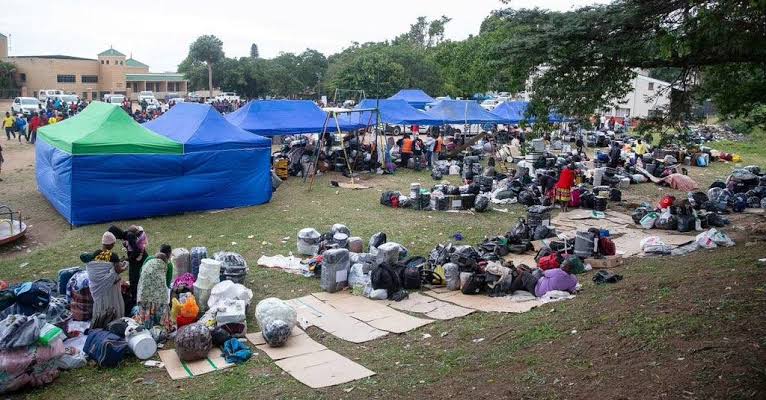
- In poor areas (informal settlements, backyard shacks), evictions are brutal, frequent, and often illegal—yet the courts routinely ratify them.
The Grootboom moment, abandoned: The Constitutional Court’s 2000 Grootboom ruling said the state must have a reasonable program to provide housing for the desperate. Twenty-six years later, the program exists on paper but fails in practice. Waiting lists for RDP houses are 12–15 years long. Meanwhile, private property developers—most white-owned, some Black-owned but always capital-aligned—receive tax breaks and fast-track approvals for luxury estates.
The spatial economy: Johannesburg’s “Corridors of Freedom” plan promised mixed-income development along transport routes. Instead, the city has seen continued gating of wealthy suburbs (Bryanston, Dainfern), evictions of inner-city buildings (Marshalltown, Jeppestown) where poor Black families have lived for decades, and privatization of public land through “strategic partnerships” with developers.
When a landless movement occupies empty land owned by a white farmer or a mining company, the courts issue interdicts within 48 hours. The occupiers are labeled “criminals,” “trespassers,” “land invaders.” When Malema calls for land expropriation without compensation, he is sentenced to prison. But when a developer evicts 200 families to build a mall, that is called “urban regeneration.”
Shelter is a right for those with money. It is a crime for those without. The magistrate’s gavel enforces that distinction every day.
VI. Health: Two Systems, One Fatal Hierarchy
South Africa has a two-tier healthcare system: a private sector for the wealthy (mostly white, with a growing Black elite) and a public sector for the poor (overwhelmingly Black). The gap between them is not incidental—it is produced and protected.
The public sector reality:
- Staff shortages (emigration of nurses and doctors)
- Medicine stock-outs (ARVs, antibiotics, anesthesia)
- Overcrowding (patients on floors, in corridors, 24-hour waits)
- Violence (gangs in trauma units, attacks on staff)
The private sector reality:
- Same-day appointments
- Private rooms with Wi-Fi
- Access to any medicine, any scan, any surgeon
- Netcare, Mediclinic, and Life Healthcare—three corporate giants controlled largely by white-owned investment funds—earn billions in profit annually
The ideological work: The state’s National Health Insurance (NHI) has been proposed since 2011. It has been delayed, watered down, and attacked by private sector interests. The message sent to the poor is: Your life is not worth the cost of fixing this system. The profits of private healthcare are more important than your survival.
A public hospital doctor who goes on strike for better conditions is called “unprofessional.” A private hospital CEO who raises fees by 15% is called “prudent.” When a mother watches her child die in a public hospital corridor for lack of a bed, there is no court case. When Malema speaks about this system as genocidal, he is charged with hate speech.
Health, like water, energy, and shelter, is a human right in the Constitution and a commodity in reality. The magistrate’s judgment against Malema is the judicial branch’s way of saying: The commodity must be protected. The right must wait.
VII. The Pattern Across Institutions: A Single Logic
Across the judiciary, water services, energy supply, housing, and healthcare, the same logic operates:
- Formal equality exists (the Constitution says so, everyone agrees in principle).
- Substantive inequality is reproduced (the outcomes are racially and class-predictable).
- The state enforces the inequality (through courts, municipal fines, eviction orders, disconnections).
- Resistance is criminalized (Malema is imprisoned; land occupiers are arrested; strikers are fired).
- The system’s failures are socialized (everyone suffers load-shedding; everyone pays for Eskom diesel).
- The system’s benefits are privatized (generators, private schools, private hospitals, legal funds).
The magistrate is not the cause. The magistrate is the enforcement mechanism. When the system needs to protect a white farmer’s land, she issues an eviction order. When the system needs to silence a Black political voice, she issues a prison sentence. When the system needs to uphold a contract that cuts off water to a township, she rules against the community.
She does not see this pattern. She sees individual cases, individual laws, individual facts. That is the genius of the structure: it reproduces apartheid outcomes without anyone needing to confess apartheid intentions.
VIII. The Human Rights Framework: Empty Promises
South Africa’s Constitution is among the most progressive in the world. It enshrines equality, human dignity, life, access to adequate housing, access to health care, food, water, social security, and children’s rights.
But a right without a mechanism is a poem. The Constitution is a beautiful poem. The reality is brutal prose.
The gap between text and life is filled by underfunded institutions (the NPA, Legal Aid, public health), private interests that capture state functions (AfriForum as private prosecutor, IPPs in energy, developers in housing), a judiciary that interprets rights narrowly when they challenge property or capital, and a political elite that benefits from the existing distribution.
The measure of a society is not what it writes in its founding documents. It is what it does to the people at the bottom. In South Africa, the people at the bottom are Black, poor, landless, waterless, energy-less, shelterless, and sick. The system does very little for them. It does a great deal for those at the top.
And when someone at the bottom—or someone speaking for them, like Malema—tries to change that, the system activates its enforcement arm. The magistrate. The police. The eviction order. The disconnection. The prison sentence.
IX. Conclusion: The Magistrate as Mirror
The April 2026 sentencing of Julius Malema is not about Julius Malema. It is about what the system will protect and what it will punish.
It will protect:
- White-owned capital
- The spatial geography of apartheid
- The privatization of basic rights (water, energy, shelter, health)
- The use of state force to maintain inequality
It will punish:
- Black political assertion
- Demands for redistribution
- Resistance to eviction, disconnection, and neglect
- Any speech or action that names the system for what it is
The magistrate, Twanet Olivier, is not an outlier. She is the perfect expression of a judiciary that has not been transformed, attached to a state that has not been restructured, serving an economy that has not been redistributed, inside a society that has not been reconciled.
She is ugly not in her face but in her function. She is the face of a system that promises equality and delivers apartheid, renamed.
The Coligny farmers walked free. Malema faces prison. A child in Makhanda drinks brown water. A mother in Durban watches her baby die in a queue. A family in Soweto cooks on a paraffin stove in the dark. A community in Cape Town fights an eviction in a court they cannot afford.
These are not separate problems. They are the same problem wearing different masks. The magistrate is one mask. The municipal manager is another. The Eskom CEO is another. The private hospital executive is another. Behind all the masks is the same face: a system that extracts wealth from Black bodies and calls it law.
The April 2026 ruling is not the beginning of this story. It is not the end. It is one moment in a long war—a war over who gets water, who gets light, who gets land, who gets health, who gets freedom. The magistrate chose a side. The structure made her choice for her.