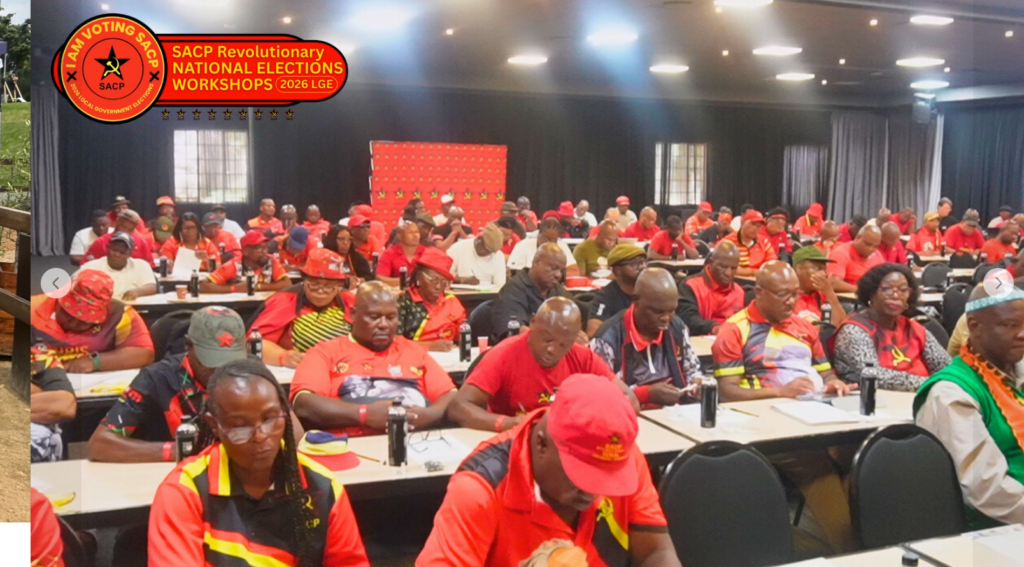
In a moment in which silence appears as complicity the websites of the Congress of South African Trade Unions (Cosatu) and the SACP show no sign of having issued a statement against March and March and the recent escalation of xenophobic rhetoric – often including classic fascist tropes – and street thuggery.
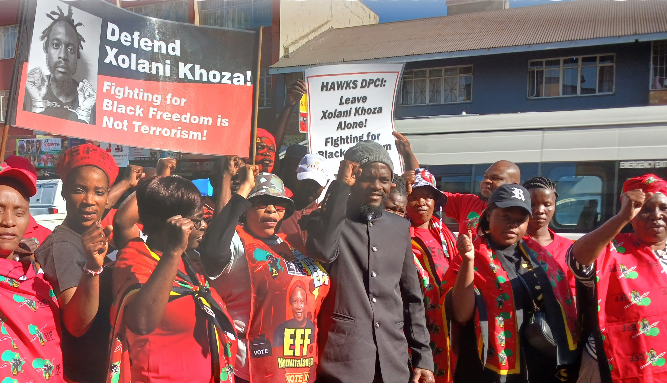
For some time now Julius Malema and the EFF have been consistently clear and principled on the question of xenophobia. In the trade unions Vavi has, as noted, been taking consistently principled positions, often confronting xenophobic paranoia and fabrication with facts. Some of the unions affiliated to Saftu, such as the General Industries Workers Union of South Africa (Giwusa), have been equally unequivocal.
Abahlali baseMjondolo has clearly and consistently opposed xenophobia since it first formed its position on the issue in May 2008. Its membership, and leadership, are open to all regardless of country of birth and it makes sure to include migrants as speakers at its major public events.
In July last year it directly confronted and humiliated Operation Dudula in Johannesburg. The fact that Abahlali baseMjondolo, which represents people from the constituency most often presumed to be the natural base for xenophobic politics, has been able to do this means that it is an objective fact rather than a moral claim to insist that there is no excuse for any other organisation to be complicit with xenophobia.
If the EFF, Saftu, unions like Giwusa, and Abahlali baseMjondolo can all take principled positions on xenophobia, there is no kind of credible excuse available to the organisations that remain silent, are directly complicit, or choose to be actively xenophobic. But, despite this evident fact, the SACP has chosen to invite the MKP to its ‘Conference of the Left’. Its current programme for the conference does not list any migrant organisations or a discussion on xenophobia. There is no condition that explicit opposition to xenophobia, and the organisations inciting and organising it, is a precondition for participation.
The initial idea for a conference of this sort was floated by Irvin Jim, the general secretary of the National Union of Metalworkers of South Africa (Numsa). At the end of last year he told the union’s central committee that Numsa should engage with Cosatu as part of a broader effort aimed at achieving the ‘unity of the working class’, overcoming the ‘fragmentation’ of working-class formations and building ‘a revolutionary agenda’. Jim also proposed a political colloquium, co-hosted with the NGO Pan Africa Today, that would bring together formations including the MKP, the EFF, Floyd Shivambu’s Mayibuye Movement and Abahlali baseMjondolo, alongside unions aligned to both Saftu and Cosatu. The stated aim would be to construct ‘a revolutionary minimum program’ capable of helping ‘unite organized working class to fight against their oppression and exploitation’.
Jim had been moving towards ‘Radical Economic Transformation’ politics for some time so his move to include MKP in his planned symposium was not wholly out of character. Nonetheless his proposal to effectively take the union movement back into the ANC shocked many people in Numsa and escalated already serious divisions. Jim has, for a variety of reasons, including those outlined by Ruth Ntolokotsi in her explosive and widely circulated letter to Jim in February, suffered a dramatic collapse in his credibility and power within the union.
Following his declaration of intent with regard to ‘uniting the working class’ Jim has also taken some openly xenophobic positions, presumably assuming that migrants are not part of the working class that requires unification. In January he tweeted a slick conspiratorial video attacking the Socio-Economic Rights Institute (Seri) after it successfully acted against Operation Dudula’s street fascism in the Gauteng High Court. More recently in widely circulated messages to the former leaders of the now functionally defunct SRWP he claimed, falsely of course, that there was ‘a wave, a deluge of immigration’.
On the first day of the Numsa special Central Committee meeting held in April Jim’s attempt to present a political report was refused. He later walked out of the meeting, which continued in his absence. No apology was tendered. Now a slate circulating for the election at the union’s congress at the end of this year does not include Jim. While Jim may be able to lend the name of Numsa to a project to realign South African politics in the interests of the ANC he cannot, in any meaningful sense, hand the union over to it, let alone its members.
It is now the SACP that is taking this project forward, with the MKP still listed as a participant. The SACP made the most significant error in its recent history by backing Zuma during his rape trial and into his presidency. The party came to regret this and in 2021 Blade Nzimande, then its general secretary, effectively described the Zuma political project as a dangerous, organised criminal-political network funded through corruption that had ‘vulgarised’ radical economic transformation and sought to ‘hijack’ the liberation movement through ‘criminals and demagogues’. He insisted that there ‘was no serious political programme … beyond the threadbare, ritualised incantation of unprocessed, empty and demagogic slogans’. The kindest understanding of the party’s first mistake with Zuma was that it was tragedy. This time around the only credible understanding is that it is farce.
Clear and firm opposition to xenophobia as an attitude and practice is not the only principle and practice by which to take measure of a left project. There are many others. You cannot, for instance, be left without also being feminist. To insist that, in a moment in which a dangerously reactionary political project is being built around xenophobia, a line must be marked out and held against any complicity with xenophobia is not to deny that there are many other lines that also need to be drawn. A principled and credible left would also refuse to welcome the MKP into a process aimed at unifying the left for many other reasons, including its authoritarian, predatory, patriarchal and ethnic character, the whole sordid story of Zuma’s record in office, and much more.
All of the people and organisations listed on the programme for the SACP Conference of the Left must, if they do in fact plan to participate, insist that their participation is conditional on:
1. The exclusion of the MKP.
2. An explicit and constitutive commitment to opposing xenophobia and the organisations – which must be named – attempting to build a political project around xenophobia.
3. The inclusion of migrant groups in the conference as participants and speakers.
4. The organisation of a strong plenary session on xenophobia that includes an examination of the political character of the wider phenomenon.
In the absence of these commitments organisations and people seriously committed to the values and project of the left should take a principled stance against participation in the conference.
Fanon provides a useful riposte to those who claim that we must be realistic and accommodate ourselves – whether in the media, the academy, politics or any other sphere – to organised xenophobic street thuggery carried out with fascist language: ‘What an idealist, people will say. Not at all: It is just that the others are scum.’
This is an extract from A Moment of Decision for the Left by Richard Pithouse: