Money, democratic control and the struggle over where power resides
The growing political power of billionaires presents the left with a contradiction that it has not adequately confronted. The problem is not only that billionaires fund the right, purchase media platforms or use private wealth to influence governments. Very wealthy individuals and foundations are also able to enter left political spaces, finance organisations and projects, and acquire influence over institutions that claim to represent working-class people. The immediate question may appear to be where the left obtains the money required to organise. The more fundamental question is where power resides once that money enters an organisation. To understand what is at stake, when we think about where power lies in left organisations it is useful to return to a period in South African history when working people developed a clear set of princples and practices around organisational democracy.
In 1973, tens of thousands of workers went on strike in Durban and Pinetown. They did so at a time when the state had destroyed the organisations that had represented the black working class in the previous decades. Along with being denied the rights to free political organising and representation, black workers were also excluded from the country’s formal industrial-relations system. The strikes were not called by any national or working-class political leadership. Following strikes in what is now Namibia in 1971 and 1972, the Durban strikes began on factory floors and spread through the industrial areas around Durban.
The trade union movement that emerged from the Durban strikes developed a particular understanding of political power. At its core was the idea that workers could not depend on employers, the state, political parties or sympathetic outsiders to act on their behalf. They had to build organisations that they controlled themselves.
This culminated in the formation of the Federation of South African Trade Unions (Fosatu) in 1979. Fosatu began with about 45,000 members and grew to more than 120,000 by 1984. Its importance did not lie only in its size. It developed an organisational form centred on strong factory structures, elected shop stewards, regular report-backs, worker education and the right of members to determine the positions taken in their name. Shop stewards were not meant to operate as a layer of minor officials standing above workers. They were workers elected by other workers and subject to their mandates. Worker control was a central principle and practice.
Worker control meant that authority moved upwards from the factory floor. Decisions taken in union structures were returned to workers for discussion. Delegates carried mandates rather than personal opinions. Full-time officials were employed to support the organisation, not to substitute themselves for it. The union existed in the factories, mines and workplaces – not primarily in its head office or in the public profile of its leaders. Its worker-education programmes, which often drew on principles and methods theorised by Paulo Freire, understood workers as people capable of interpreting society and producing political ideas from their own experience. In Gramsci’s terms, they helped to produce organic intellectuals from within the working class rather than importing a separate group of experts to think on its behalf.
This was not simply a method for administering a trade union. It contained a much larger political idea. Workers who learnt to control their own organisations could begin to imagine controlling their workplaces and, ultimately, the society in which they lived. The democracy of the future was not imagined to be a matter of voting for leaders every few years. It was imagined in terms of collective decision-making in ordinary life. This is why ‘Building tomorrow today’ became an important slogan for the unions.
These democratic commitments and practices gave concrete organisational form to Marx’s insistence that the emancipation of the working class had to be achieved by workers themselves. It was understood that socialism delivered to workers by a party, state or intellectual elite would preserve the division between those understood to have a right to rule and those expected to follow. These kinds of ideas were later taken into the United Democratic Front, formed ten years after the Durban strikes. Ideas like community control and popular power became central, along with commitment to democratically developed mandates.
Fosatu’s emphasis on worker control was sometimes dismissed as ‘workerism’, as though attention to the organisation and political development of workers was a retreat from the wider struggle against apartheid rather than a profound deepening of it. Building democratic working-class power was not a narrow or apolitical project. When black workers insisted on the right to organise, elect representatives, withdraw labour and determine the direction of a union, they were challenging the state and racial capitalism along with the authority of the employer. They were also anticipating and building an emancipatory future.
In a famous speech given in 1982 Joe Foster, then Fosatu’s general secretary, argued that workers needed to develop their own coherent and independent politics. This did not require separation from the wider struggle for national liberation. It meant that the working class could not simply be summoned behind a national political project designed elsewhere. Without its own institutions, political understanding and capacity to act, it would enter the wider struggle as a large constituency for a project directed by others with the risk that, after the end of apartheid, that project would be in the interests of national elites rather than workers.
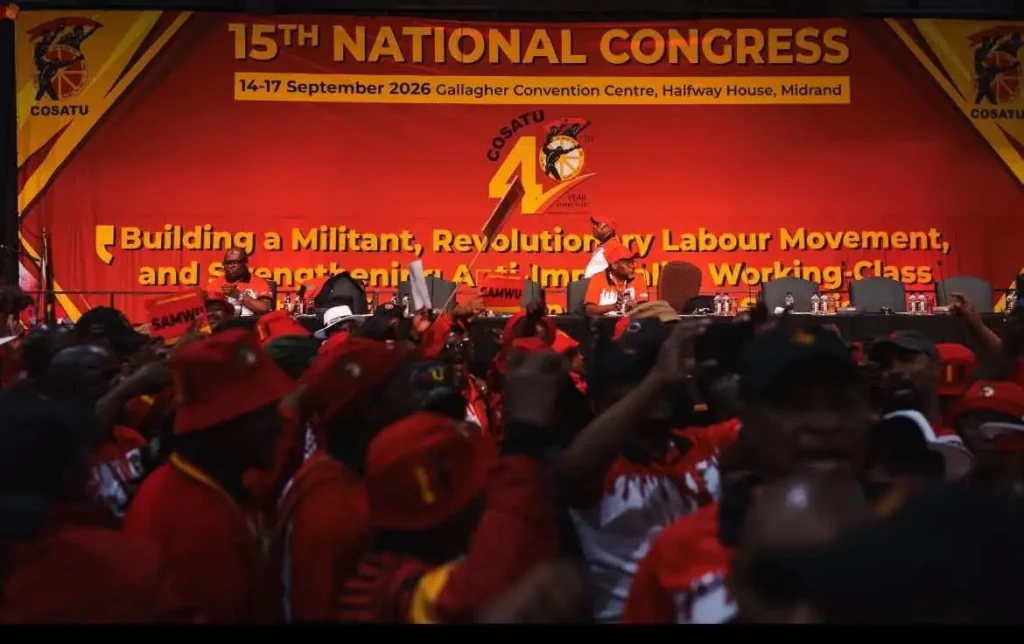
The formation of the Congress of South African Trade Unions (Cosatu) in 1985 brought the trade union movement much closer to the African National Congress (ANC), although not openly so. It did not abandon the commitment to worker control though. COSATU’s early positions defined worker control as central to its organisational approach. It insisted that workers should control all the structures and committees of the federation and that union delegations should contain a majority of shop-floor workers rather than being dominated by full-time officials. The purpose was explicit: to prevent bureaucratisation and ensure that the federation was not dependent on offices or a small number of leaders.
This history matters because worker control is frequently invoked on the contemporary left while its actual content has been steadily emptied out. In some instances, it has become little more than a term used to mask authoritarianism, corruption and even outright capture.
A union may hold congresses, conduct elections and retain formally democratic constitutions while power moves away from its members. Meetings take place, resolutions are adopted, and worker control remains part of the official language. But the significant decisions may already have been taken elsewhere: in meetings between senior officials, in the offices of political parties, in negotiations with the state, through alliances with business, or in private discussions with the people who control access to money.
Rosa Luxemburg’s warnings about bureaucratic socialist parties were directed at precisely this substitution of leadership for political activity. She insisted that organisation was necessary, but that no leadership could exercise democratic power on behalf of people who had ceased to exercise it themselves. The constitutional structure of a union or federation may survive while the political organisation underneath it changes.
The political risks of bureaucratisation intensified as unions grew. Cosatu expanded from fewer than half a million members at its formation to more than 1.2 million by the beginning of the 1990s. Large national unions required full-time staff, legal departments, research units and increasingly complex administrative systems. These developments were not inherently opposed to worker control. Workers require institutions capable of confronting large corporations and the state. But institutional growth also created a permanent professional layer with access to information, resources and political networks that ordinary members did not possess. Robert Michels identified this tendency in his study of the German Social Democratic Party: organisational complexity allowed permanent officials to monopolise knowledge and administration until the survival and interest of the leadership began to displace the political purpose of the organisation. Worker control was an attempt to build practical defences against this tendency.
These internal pressures within the union movement converged with the political changes taking place as apartheid came to an end. Cosatu did not develop in isolation from the national liberation movement. Its formation had brought organised workers closer to the African National Congress (ANC), and the unbanning of the ANC in 1990 created the conditions for that relationship to become open, formal and increasingly institutionalised. The transition therefore transformed both organisations at the same time. Union leaders gained access to the senior structures of the Alliance, the negotiations over the new political order and, eventually, positions within the state. The ANC, in turn, acquired an organised working-class constituency and a layer of experienced leaders, organisers and intellectuals formed within the unions. This convergence could have strengthened working-class power within the national liberation movement. But it also created new routes through which political authority could move away from workers and towards party, state and professional structures.
The ANC entered the democratic period with immense popular legitimacy. It had branches, allied organisations and a political authority built through decades of struggle. But the unbanning of the movement also transformed its material circumstances. Exile structures returned home. Elections required substantial funding. A national bureaucracy had to be established. The movement entered government and gained control over appointments, procurement and state institutions. Business recognised that access to the ANC increasingly meant access to the state.
Money entered the organisation through corporate donations, fundraising networks, business interests and relationships between political leaders and private capital. The ANC’s investment arm, Chancellor House, made the problem particularly visible: a governing party could benefit from commercial relationships in sectors over which its government exercised public power. The boundary between raising resources for the organisation and using political authority to accumulate personal wealth became increasingly difficult to maintain.
Things got significantly worse over time. The rise of the Gupta family was the most grotesque development in this wider degeneration of the ANC. The Guptas did not acquire mandates from ANC members or earn authority through democratic process within the ANC. They built relationships with strategically placed leaders and officials. Their influence operated through access, money and personal dependency. They became involved in decisions over appointments and state institutions despite having no democratic standing from which to exercise such power. The state was looted on a massive scale to the point where it became necessary to start speaking about kleptocratic practices.
The significance of the Gupta case cannot be reduced to the vulgar conduct of one family or the personal corruption of individual politicians. The Guptas became an alternative site of power. Formal authority remained with ministers, boards, public officials and ANC structures. Real decisions migrated into private relationships that citizens and ordinary ANC members could neither see nor control.
The Zondo Commission found that the ANC enabled state capture by protecting Jacob Zuma and failing to confront evidence of corruption until the damage had become extensive. It also found that the politicisation of public appointments through cadre deployment created conditions in which state capture could flourish. A practice initially defended as a way to ensure that a democratic government could implement a transformative mandate became a means through which appointments were decided within party structures and later manipulated by private interests.
Capture works by hallowing out democratic institutions. Parliament continues to sit, party conferences continue to meet, and officials continue to occupy legally constituted offices. But decisions are produced within relationships and networks that the formal structures no longer govern.
The ANC emerged from one of the great liberation struggles of the twentieth century and included communists, trade unionists and generations of activists committed to popular democracy. Its degeneration cannot be dismissed as evidence that it was never genuinely liberatory. Nor is it in any way unique.
Frantz Fanon warned that the organisations leading the struggle for national liberation could become instruments through which a narrow political class negotiated its own access to the state and the economy. Amilcar Cabral’s insistence that the leadership of a liberation movement had to relinquish the privileges associated with its social position addressed the same danger. The degeneration of the ANC is one of many tragic collapses into political decay when access to the state, business and private wealth becomes more politically decisive than the capacity of people to exercise control over the organisation built in their name.
After apartheid there were also swift changes to the practices within the union movement. The distance between workers on the shop floor and union bureaucrats in national offices rapidly widened. Leadership often became a career. Many union leaders moved into government, parliament and business. The political standing that they had acquired through workers’ organisations became a route into forms of power no longer controlled by workers.
The now open and formal alliance with the ANC and the South African Communist Party (SACP) created another location of authority. Union leaders participated in political structures whose decisions were not determined by shop-floor mandates. Strategic questions were increasingly negotiated between organisational elites. Workers remained the main constituency of the alliance but were not necessarily its political authors.
There were other important changes at this time. One was the formation of union investment companies. Some acquired vast wealth, and some individuals became very rich. New forms of temptation and power were generated, and without a firewall between the personal interests of union leadership and the investment companies, significant damage was done to many unions.
There was also a significant shift in the left from popular democratic forms of working-class power towards NGOs. This created new centres of class power which were neither elected nor accountable to a mass base. While there have been NGOs that have supported worker power and community power, they are rare exceptions to a general tendency to develop new forms of class-based power over working class people.
Donor foundations also began to acquire significant power over working class organisations, often by bringing leaders onto their payroll or arranging for personal access to benefits such as international travel. Donors were often able to set agendas and design campaigns for working class organisations that did not resonate with their members. When the members of a popular organisation no longer control it, that organisation is always rapidly weakened.
None of this means that unions ceased to matter or that every leader abandoned the interests of workers. South African unions continued to organise strikes, bargain collectively and defend their members under extraordinarily difficult conditions, conditions that were rapidly worsening due to massive deindustrialisation. But while some leaders remained committed to principle, the institutional mechanisms designed to keep power on the shop floor became weaker. Worker control increasingly described a historical inheritance reduced to an empty slogan rather than a living organisational practice.
In recent years there has been, in many countries and in relation to many left organisations, a new and serious challenge which is the entry of large sums of private money into the left. As billionaires acquire greater and greater power in society they have not only funded the right. Billionaires have also acquired significant power over some left organisations and projects.
The left needs money. Organisers must be paid. Workers need transport to meetings. Strikes require material support. Legal challenges, political education, research and communication all require resources. There is nothing politically virtuous about an organisation being too poor to function.
The anti-apartheid struggle itself depended heavily on international solidarity. Sweden provided millions of dollars in support to the struggle, including assistance to the ANC, independent trade unions and other anti-apartheid organisations. The International Defence and Aid Fund for Southern Africa international resources to defend political prisoners and support their families. Foreign funding sustained organisations confronting one of the powerful states on the African continent.
External funding does not, by itself, destroy democratic politics. The important question is the relationship between resources and democratically derived political authority.
When funding is placed at the disposal of an organisation with its own membership, leadership, strategy and internal political life, it always carries risks, but, if properly managed, it can expand the organisation’s capacity to act. When there are genuinely democratic practices in an organisation and genuine democratic control of funding, the donor provides resources, but the movement remains the political subject, and its leaders do not derive their authority from access to the funder.
The form and consequences of donor funding swiftly changed after 1994. As the popular organisations of the anti-apartheid struggle weakened, donor-funded NGOs acquired increasing prominence. The Open Society Foundation for South Africa began operating in 1993, as the country prepared for its first democratic elections. In 2015, it joined the Ford Foundation and Atlantic Philanthropies, represented by the Social Change Initiative, to establish the Constitutionalism Fund. According to the Fund, the three foundations made a joint investment of $29 million to promote constitutionalism in South Africa over ten years.
Much of this funding supported important work. It contributed to legal reform, education, public health, independent media and the defence of constitutional rights. South Africa would be considerably poorer without many of the organisations that received it.
But the rise of the NGO also changed the meaning of political representation. An organisation did not have to build a large constituency to become an authoritative voice in public life. It needed professional expertise, donor recognition, media access and the capacity to produce the forms of work that funders were prepared to support. NGOs frequently substituted for popular membership-based organisations.
The language of politics changed with the organisational form. People became ‘beneficiaries’ or ‘affected communities’ rather than comrades or protagonists of their own struggles. Political programmes became ‘projects’. Organisational objectives were translated into measurable outcomes. Political education was replaced with ‘capacitation’. Accountability increasingly travelled upwards through funding reports rather than downwards through mandates and report-backs.
Issa Shivji’s critique of NGOisation is important because it identifies this as a political transformation, not simply a technical change in the way organisations are financed. When professional organisations substitute themselves for popular organisation, those experiencing exploitation are no longer the makers of politics. They become the objects of interventions designed elsewhere. Walter Rodney’s understanding of intellectual work is useful here. For Rodney, radical knowledge could not remain the property of universities, professional revolutionaries or political experts. It had to become part of the collective political activity of working people and be tested within their struggles. Expertise may assist an organisation, but it cannot become an independent source of political authority over the people whose lives are being discussed.
The Treatment Action Campaign demonstrates that donor funding does not inevitably produce this result. The TAC received most of its funding from outside South Africa, including from foundations, development agencies and foreign governments. Yet its political force came from organising people living with HIV, developing treatment literacy, building branches and combining mobilisation with litigation. Its 2002 national congress decided to confront the government over access to treatment, leading to a march on Parliament and a civil-disobedience campaign.
The important point is not that TAC was without internal contradictions. No serious organisation is. It is that external funding supported an organisation whose political direction was produced through mobilisation, education and collective decision-making. Money expanded a political capacity that had been built among people directly affected by the issue.
This is vitally different from donor control. It also different from an extremely wealthy individual entering the left and constructing a political project around their own resources.
A donor can establish an institute, employ intellectuals, finance media platforms, support campaigns and provide selected leaders with access to resources that no membership-based organisation can match. Within a short period, the funder can acquire an influence that organisers may spend decades building. The resulting project may use the language of socialism, labour or popular struggle. It may finance valuable work. But where does its political authority come from?
It does not come from workers electing leaders on the shop floor. It does not come from branches developing mandates. It does not come from a constituency capable of holding the project to account. It comes from private ownership of wealth.
It must be kept in mind that even when a donor does not enter a left space, as some do, with the aim of capturing it, the massive power imbalances between the holders of wealth and those without wealth create real temptation for the donor – whether a foundation or individual person – to start to take more and more power over time. There are many cases where a donor started out with the aim of respecting the autonomy of a left organisation or project but slowly succumbed to the temptation to exercise greater and greater control. In some instances, a change of power relations within a donor organisation can generate a sudden change from respect for autonomy to direct attempts to seize control.
This is the left’s billionaire problem.
The right does not experience funding from billionaires as a contradiction. Charles and David Koch spent decades financing think tanks, university programmes, advocacy organisations and political networks that moved American politics to the right. Peter Thiel has used his wealth to support political candidates and intellectual projects aligned with his own views. Elon Musk acquired X and used control of the platform to intervene directly in political life.
These billionaires do not claim that their influence derives from popular democratic organisation. The authority of the capitalist is already central to right-wing politics. Wealth is treated as evidence of superior ability and as an entitlement to exercise power.
The form of organisation of the contemporary right is also routinely concealed by the claim that it represents spontaneous popular anger. Anti-immigrant politics is presented as the natural response of communities abandoned by the state. This description disguises the political work required to select migrants as the explanation for unemployment, crime, collapsing public services and the general insecurity produced by South African capitalism.
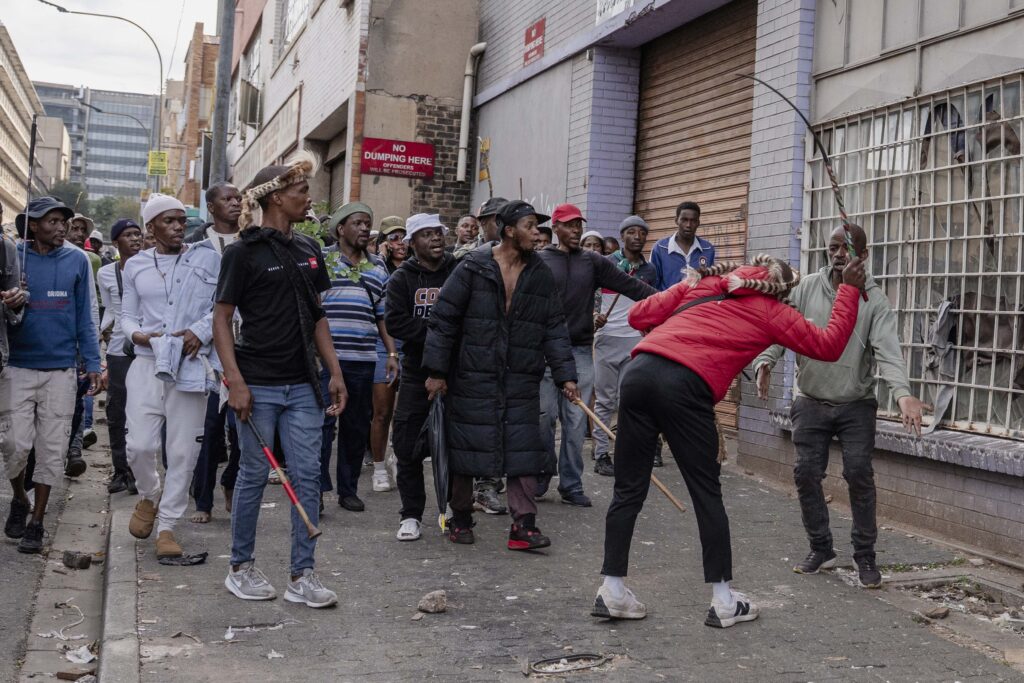
March and March offers a contemporary example. Established in 2024, it has grown from a KwaZulu-Natal campaign into a national anti-immigration movement. It organises marches, runs communication platforms and has announced repeated demonstrations across the country. It has worked alongside Operation Dudula and has received support at marches from parties including the uMkhonto weSizwe Party, Patriotic Alliance and ActionSA. Its members have moved beyond protest to attempts to exclude migrants from public hospitals and clinics and to door-to-door campaigns demanding that people prove their immigration status. Its actions have often resulted in violence.
This is not, as the media so often claims, spontaneous anger. It is well organised and well-funded right-wing politics.
Marches require transport, sound equipment, marshals, publicity, communications staff and sustained coordination. A movement operating across the country, maintaining an online infrastructure and planning repeated national actions requires resources. Yet the financing of March and March and the wider anti-migrant movement remains opaque. Its leadership has denied allegations of proxy or foreign funding and maintains that it is a grassroots movement. Those denials do not answer the broader public question: who pays for the infrastructure that allows this politics to expand?
The absence of a publicly established funder does not mean that we should invent one. It means that journalists, researchers and democratic institutions should investigate the material organisation of a movement whose activities have consequences for the safety and rights of millions of people.
The far right has always presented carefully organised fear as the authentic voice of ordinary people. Economic and political failures are condensed into the figure of an enemy. In South Africa, migrants are blamed for unemployment produced by decades of deindustrialisation, for the failure of the public-health system, for housing shortages and for crime. The political forces responsible for these conditions disappear from view.
This is precisely why the right’s funding and organisational networks matter and must be rigorously and publicly interrogated.
But the same is true of the foundations and very wealthy people that now fund left organisations and causes. A wealthy funder may support labour rights, anti-racism, climate justice or anti-imperialist politics. The immediate work may be useful. But if the funder can determine which institutions exist, which organisers are employed, which leaders are elevated, and which political positions receive resources alternative centres of power are swiftly created.
A donor constructed centre of power may operate alongside a union or movement without appearing in its constitution. It may have no formal power to issue instructions. But access to money produces its own discipline. Organisations learn which proposals or projects will be supported. Individuals understand which positions provide access and which questions place that access at risk. Decisions begin to anticipate the preferences of the funder without the funder having to articulate them.
The danger is greatest when the relationship moves from institutional funding to personal patronage. If access to private wealth begins to determine the material lives of political leaders, the democratic chain of accountability is broken. A worker may vote against a leader at a congress. The worker cannot vote out the person financing that leader’s political or personal position.
The existence of elections does not repair this problem. Members can formally choose between candidates while the conditions under which leadership is produced have already been shaped elsewhere. Those with access to money can employ staff, travel, organise events, control communication and build political profiles. In some instances, they can buy a congress in the same way that ANC elections can be bought. Those without donor money cannot compete on equal terms.
Private money does not have to purchase a specific decision to change an organisation. It can change the balance of forces inside the organisation with the result that decisions amenable to the funder follow naturally.
The same movement of power occurs when the left replaces organising with social-media influence. The right has developed a political method based on fear, constant crisis and the production of enemies. Its messages are amplified by platforms that profit from anger and conflict. The result is a politics in which people react continuously but exercise very little collective power.
The left cannot answer this by producing its own version of the same spectacle. A large online following is not a substitute for organised workers. A viral campaign cannot mandate a leader. Political authority cannot be measured in reposts.
This does not mean abandoning social media. It means placing communication under the discipline of organisation. The purpose of a message should be to support organising, deepen political understanding or make collective action possible. When the performance becomes the politics, the people controlling the account acquire authority without having to build democratic structures.
Zohran Mamdani’s 2025 campaign for mayor of New York provides an important counterexample. His campaign made exceptional use of social media. Its short videos were clear, funny and politically disciplined. They gave a socialist candidate a public reach far beyond the established left. But the campaign did not confuse attention with organisation.
Mamdani was already a member of the Democratic Socialists of America and received its endorsement through an internal vote. Thousands of volunteers then knocked on more than a million doors during the Democratic primary. The campaign spoke to people about rent, transport, childcare and the cost of living. The digital campaign directed attention towards a material programme and a field operation. People who encountered Mamdani on a screen were invited into political activity beyond it.
The campaign’s financing also mattered. New York City’s public-finance system matches qualifying small contributions from residents with public funds. Campaign Finance Board records show that Mamdani received more than 54,000 individual contributions during the 2025 election cycle, with an average contribution of about $74. This allowed a campaign based on large numbers of ordinary donors to compete with candidates supported by wealthy interests and super PACs.
Andrew Cuomo entered the Democratic primary with establishment recognition and the support of a super PAC funded by wealthy donors. Mamdani defeated him through the combination of a clear material programme, public financing, small donations, organised socialist support and an immense volunteer operation.
Mamdani’s campaign should not be romanticised or treated as a model that can simply be copied into different political conditions. Electoral campaigns are not the same as trade unions or durable popular organisations. Public office also creates its own pressures, and the relationship between an elected socialist and the organisation that helped elect him will continue to require democratic negotiation and accountability.
But the campaign demonstrates an important principle. Effective communication, electoral organisation and substantial resources do not have to be controlled by a billionaire. Money can be aggregated from large numbers of people and supplemented by democratic public funding. Social media can draw people into organisation rather than reducing them to an audience. A candidate can emerge from a political organisation rather than assembling a temporary personal vehicle around wealth and celebrity.
The contrast is not between purity and effectiveness. It is between two ways of building political capacity. In one, money and communication are concentrated in the hands of a donor, leader or professional apparatus. In the other, resources are assembled through institutions that allow large numbers of people to participate. Both may produce impressive campaigns. Only one begins to alter who exercises political power.
The problem is therefore larger than the conduct of individual donors or leaders. It concerns the location of the primary sites of power on the left. Bringing democratic control back to the left cannot mean invoking worker control at union congresses while leaving existing relations untouched. It requires rebuilding the organisations through which working-class people exercise power in their ordinary lives: in workplaces and unions, but also in communities, schools, universities, informal employment, struggles over housing, public services and the cost of living. People must be able to determine the direction of organisations that claim to act in their name, whether they are employed, unemployed, precariously employed, studying, raising families or trying to survive through informal work.
Meetings must produce decisions and mandates rather than simply receive reports from leaders. Representatives must return to the people who elected them, explain what they have done and remain subject to correction and removal. Political education must enable people to interpret their own conditions, assess competing arguments and challenge those in authority, not train them to repeat an official line. Within unions, shop stewards must remain accountable to functioning workplace constituencies, while union finances, investment companies and donor relationships must be open to meaningful scrutiny by members. Outside unions, community organisations, social movements and political formations require the same forms of accountability. The fundamental principle is that authority must move upwards from people acting together, rather than downwards from leaders, parties, experts, donors or self-appointed representatives.
Trade unions still remain among the most important organisations through which working-class people can exercise collective power. Their officials possess the expertise necessary to modern trade unionism, but that expertise must remain subordinate to workers’ authority. The same principle applies across the left. Political parties, community organisations, social movements, research institutes and campaigning organisations require skilled organisers, researchers and officials, but expertise cannot become an independent source of authority. Political alliances may be valuable, and external funding may support education, research or organising, but neither can be permitted to displace the people from whom an organisation claims its legitimacy.
To argue for democratic control in the popular organisations of the left is not nostalgia for the unions or political movements of the 1970s. The working class has changed. Millions of people are unemployed, informally or precariously employed, studying, raising families without adequate public support or trying to survive through labour brokers and digital platforms. Their political lives are shaped in workplaces, but also through struggles over housing, education, healthcare, transport, land, migration and the cost of living. Trade unions remain leading organisations of the working class, but they cannot be its only organisational form. New institutions must be built through which people can understand their conditions, develop collective demands and exercise control over the politics conducted in their name.
Worker control was never meant to be a ceremonial phrase confined to trade unions. It expressed a wider theory of democratic power: that people should be the authors of their political lives rather than spectators of decisions taken by leaders, parties, experts or funders.
That is the question the left must ask again: whether it is building the collective power of people to act or merely constructing new institutions that act on their behalf.