John Rees looks at a recent controversy in academic Marxism
Republished from Counterfire.org
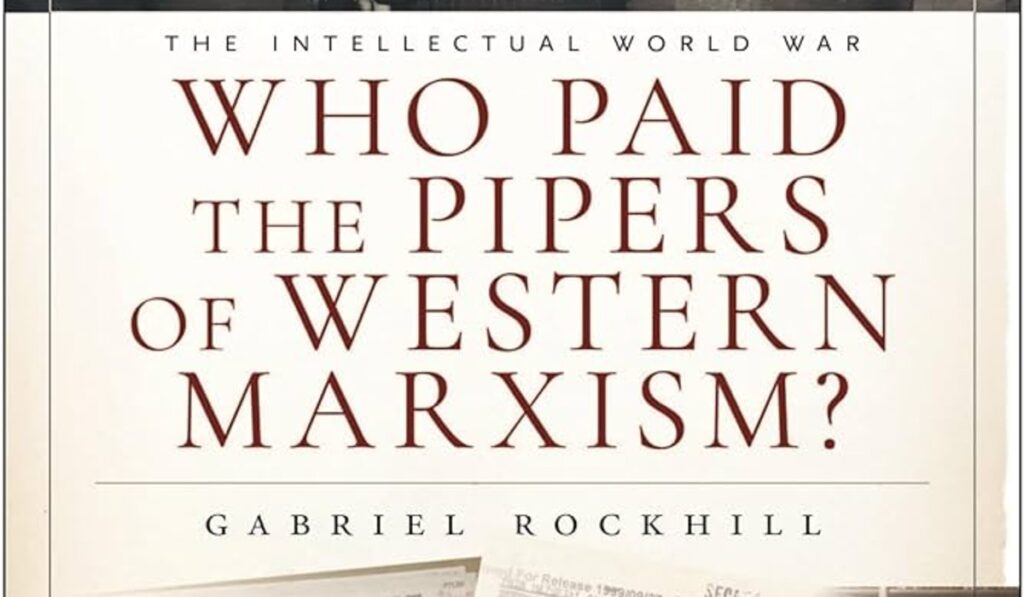
Christmas is a time for comedy specials, and this year has produced a lulu: the social-media ‘debate’ over Gabriel Rockhill’s book Who Paid the Pipers of Western Marxism?[1]
A lot of the spat on social media has to do with the pre-publication assessments of Rockhill’s work, but that has now widened out into a debate on his central contention that Western Marxism was to a significant degree a CIA-funded intellectual trend dedicated to smearing ‘actually existing communism’.
‘Western Marxism’ is itself a portmanteau concept popularised by Perry Anderson’s tour de force Considerations of Western Marxism.[2] In this trailblazing account, Western Marxism begins with George Lukács and Antonio Gramsci and then evolves through work by theorists whose work became influential in the post Second World War II era: Theodore Adorno, Max Horkheimer, Walter Benjamin, and Herbert Marcuse, among others.
Like most of the commentators, I have not read Rockhill’s new book, but I have read the articles in which his theory has been developed.[3]
The first thing to say is that Rockhill is not wrong about the weaknesses of the later exponents of Western Marxism. They were undoubtedly obscurantist in expression and made crucial compromises with Western Cold War ideology. This, however, is not a new thought. In the 1977 collection, Western Marxism A Critical Reader, Göran Therborn was writing of ‘The Political Collapse of Horkheimer’, which covers many of the issues Rockhill raises.[4]
In some ways, Rockhill is not as nuanced as earlier accounts. Despite protestations that his approach is not reductionist, it is the crudest of determinism to suggest that, say, Marcuse’s Reason and Revolution cannot be read with profit by any socialist, notwithstanding the wider frailties of Marcuse’s politics.
But, leaving the reductionism aside, the explanation for the development of Western Marxism in Rockhill’s thesis is inherently problematic. Despite lots of talk of a socially rooted explanation of the totality of relations that produced Western Marxism, Rockhill’s core message is actually shallow and undialectical, overly dependent on the single idea that the CIA funded various programmes from which the Western Marxists benefited and that this was the proximate cause of their views.
In fact, this is such a narrow and misleading framework that it borders on a conspiracy theory. Let’s stand back and see if we can briefly indicate what a more satisfactory account might look like.
Firstly, Western Marxism, as Anderson was clear, is not all the same thing. Lukács and Gramsci were rooted in the Bolshevik tradition, as active militants, imbued with classical Marxism. The later exponents, the so-called Frankfurt School, were none of these things.
Their thought was shaped by massive global events on a scale far greater than anything that even the CIA could imagine. These, in chronological order, were the defeat of the Russian Revolution and the rise of Stalinism, the catastrophe of European fascism, and the onset of the Cold War.
As Anderson’s original analysis pointed out, the immediate institutional effect of this was that while the home of the first generation of thinkers was the labour, specifically Marxist, movement and its party organisations, the later generations were entombed in academia. This was accompanied by a theoretical shift from economic and political preoccupations to cultural and philosophical issues. As Therborn notes, ‘the post-War position of Horkheimer and Adorno … had three aspects: the maintenance of critical theory as a pure theory; the retreat from politics into exclusive individualism; and academic integration.’[5]
Rockhill claims his analysis is a dialectical totality, but it is not. It does not integrate the various levels of historical reality into a single, but mediated, whole. In particular, for instance, the way that CIA influence worked at all was mainly through academia, supporting institutes, publications, conferences and so on.
Academic myopias
Rockhill claims that his analysis ‘does not accept the arbitrary dividing line that many petty-bourgeois academics desperately try to erect between intellectual production and the broader socioeconomic world, as if someone’s “thought” could—and should—be separated from their “life,” as well as from the material system of theoretical production, circulation and reception that I will here refer to as the intellectual apparatus.’[6] But in emphasising the CIA’s role, Rockhill diminishes the disastrous and central role that academia as a whole has played in undermining the classical Marxist tradition and its relationship with political activism and revolutionary organisation.
In this, Rockhill is sharing in the long-standing inability of academics to turn the searchlight of Marxist analysis on their own institutions. Yet academia, with its financial and political power, its employment and promotion capacities, its gatekeepers, its means of publication and preferment is a major practical force shaping modern Marxism. Ideologically, these institutions favour idealist, latterly post-modernist, theoretical positions and denigrate organised political participation. Such institutions need to be critically analysed in the way that any other department of the capitalist state, the civil service or the legal profession for instance, are examined.[7]
Rockhill’s blind spot here is perhaps due to the fact that he is himself a product of exactly the same high-academia that nurtured the later exponents of Western Marxism. He earned his Master’s degree studying in Paris under Jacques Derrida, the idiot-savant of postmodernism, and his PhD studying under Alain Badiou. Like the Western Marxists he so detests, Rockhill seems to have no specific party affiliation, or history as a labour-movement organiser.
It is similarly convenient for Rockhill not to examine the wider historical context of Western Marxism since this would mean a critical engagement with the rise of Stalinism and the extension of the Stalinist system to Eastern Europe after World War II.
Rockhill is a supporter of these regimes, and it is therefore easier to blame the CIA for Western Marxism’s hostility to Stalinism than it is to admit the grotesque counter-revolutionary nature of the Stalinist states. The CIA certainly has its own assassination programmes, but it was not the CIA that liquidated the entire Bolshevik leadership of 1917. That was the Stalinists. And the CIA certainly has its own black sites, but the Gulag was a Stalinist form of mass repression and persecution.
Rockhill is keen to set up a mutually reinforcing dualism where there is only ‘really existing socialism’ and ‘CIA funded anti-communism’. You must, in this schema, be in favour of one or the other.
But of course, this is fundamentally untrue. There have been anti-Stalinists from within the Communist tradition, like the Communist Party Historians Group members, including Edward Thompson and Christopher Hill, who left the CPGB over the Stalinist repression of the Hungarian Revolution in 1956.
And, crucially, the Trotskyist tradition has, whatever its faults and shortcomings, maintained a revolutionary socialist critique of Stalinism. Indeed, it is the only Marxist tradition which has sustained an anti-imperialist, anti-reformist, anti-Stalinist, revolutionary socialist orientation while remaining a key part of the wider labour and trade-union movement.
This is a central question of modern politics. Socialists who are ardent defenders of democratic rights in their own countries, fervent advocates of free trade unions at home, can scarcely be expected to be taken very seriously if in the case of other countries, China for instance, they are the trumpeteers of avowedly capitalist economies with repressive state apparatuses.
And it does no good to point out, accurately, the shortcomings of parliamentary democracy if your model of socialism is one in which there are less, not more, democratic rights. Socialism is the extension of democracy from politics to economics, not the eradication of even the limited political rights that have been attained in some capitalist states. Democracy was not a ‘bourgeois luxury’ for Marx and Engels, for Lenin or Luxemburg, it was an essential defining characteristic of Communism.
In 1989, when the Stalinist states in Eastern Europe fell under the impact of mass rebellion from below, the effect on orthodox Communist Parties the world over was shattering and the demoralisation of militants widespread. Today’s neo-Stalinists are, on a much-reduced scale, only preparing future disappointments. No section of the left needs to die on that hill, again.
[1] G. Rockhill, Who Paid the Pipers of Western Marxism? (New York: Monthly Review Press, 2025).
[2] P. Anderson, Considerations of Western Marxism (London: Verso, 1976).
[3] G. Rockhill, ‘The CIA and the Frankfurt School’s Anti-Communism’, The Philosophical Salon. ‘The CIA Reads French Theory’, The Philosophical Salon.
[4] G. Therborn‘The Frankfurt School’, in Western Marxism A Critical Reader (Loneon: Verso, 1977), pp.106-10.
[5] ibid. p.107.
[6] G. Rockhill, ‘The CIA and the Frankfurt School’s Anti-Communism’.
[7] For my thoughts on this see J. Rees, ‘Revolutionary Marxism and academic Marxism’ in J. Rees (ed), Essays on Historical Materialism (London: Bookmarks, 1998), pp.161-75.
John Rees
John Rees is a writer, broadcaster and activist, and is one of the organisers of the People’s Assembly. His books include ‘The Algebra of Revolution’, ‘Imperialism and Resistance’, ‘Timelines, A Political History of the Modern World’, ‘The People Demand, A Short History of the Arab Revolutions’ (with Joseph Daher), ‘A People’s History of London’ (with Lindsey German) and The Leveller Revolution. He is co-founder of the Stop the War Coalition.