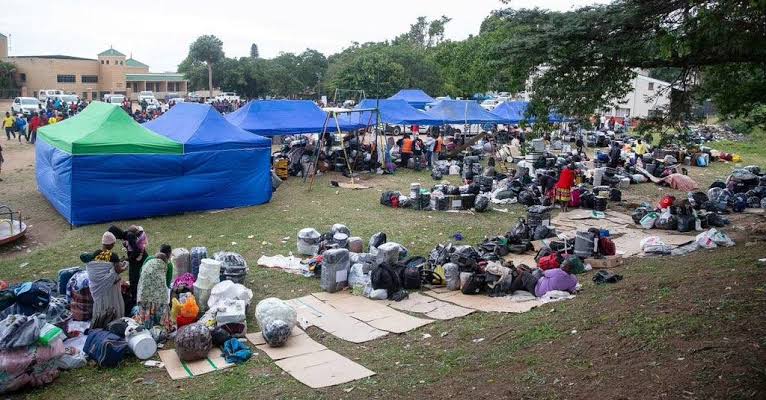

Gqeberha is once again confronting a deepening water crisis that exposes not only infrastructural decay and municipal failure, but also the enduring realities of racial capitalism marked by water apartheid and neoliberal governance in South Africa. While officials continue to frame the crisis as a technical or climatic challenge, lived experiences across the city reveal a far more political story — one shaped by a stratified society ordered according to racial and class power. The water crisis poses a question of whose lives are deemed worthy in a market society.
For working-class communities, particularly in townships and informal settlements, water shut offs have become the rule rather than the exception. Taps run dry for days and sometimes weeks, forcing households to queue for water tankers, rely on neighbours, or enter exploitative arrangements. These conditions undermine health, dignity, and social reproduction, especially for women, children, the elderly, and the sick. This is not a new problem but rather the legacy of racial capitalism’s historical development in South Africa.
Water Apartheid in a Post-Apartheid City
The current crisis cannot be understood without confronting the legacy of apartheid spatial planning. Under apartheid, Black communities were deliberately under-serviced, while white suburbs enjoyed secure and well-maintained infrastructure. Although political apartheid has formally ended, water apartheid persists in new forms.
In Gqeberha, water access still mirrors the geography of racialised class divisions mapped by the South African apartheid regime. Wealthier and historically white suburbs experience fewer and shorter interruptions, faster repairs, and clearer communication. In contrast, working-class Black communities endure prolonged outages, inconsistent tanker services, and limited avenues for recourse. These patterns are not accidental; they are the outcome of policy choices, budget priorities, and political power.
Learning from Previous Crises
This is not Gqeberha’s first brush with water scarcity. Past droughts and near–Day Zero moments already revealed how crisis responses tend to prioritise those with economic and political influence. Yet little has been done to institutionalise lessons from past crises to protect vulnerable communities.
Instead of using history as a guide to transform water governance, the municipality defaults to reactive management and short-term fixes. Municipal authorities lie in wait for the dams to refill and mitigate the crisis, staving off fundamental reforms. Emergency measures roll out unevenly and accountability is deferred until market nature trickles down rainfall, filling the dams, and supposedly lifting all boats back to safety. The result is a city permanently locked into crisis mode.
Austerity, Cost Recovery, and Racialised Inequality
At the heart of the crisis lies a governance model shaped by austerity and cost recovery. Municipalities receive a limited share of the national budget and are pressured to operate like businesses, selling water to generate revenue. In a city marked by unemployment and poverty, this model entrenches inequality.
Working-class households are expected to pay for a service that is unreliable or absent, while facing disconnections, inflated bills, and mounting debt. Meanwhile, maintenance backlogs grow and skilled capacity within the municipality is hollowed out. Austerity does not produce efficiency but rather abandonment.
Faulty Meters and the Criminalisation of the Poor
The crisis is further intensified by a deeply flawed metering and billing system. Residents have repeatedly reported receiving excessive water bills during periods when no water was supplied. Faulty meters that register air pressure in empty pipes have translated infrastructural failure into household debt.
Rather than recognising this as a systemic problem, the municipality often blames the end-users, residents, as defaulters. This criminalisation of poverty reproduces racialised assumptions about irresponsibility, while shifting blame away from governance failures.
Corporate Privilege and Water for Profit
While working-class communities are conditioned to discipline their water consumption in the name of conservation and cost recovery, large commercial users continue to enjoy uninterrupted water service. Industries that consume vast quantities of water for profit are rarely subjected to the same scrutiny, restrictions, or moral judgement placed on households.
This reveals a fundamental contradiction: in moments of scarcity, water is protected for capital before it is protected for life. The needs of people are subordinated to economic interests, reinforcing a political economy in which water is treated as an input for accumulation rather than a public good.
Racism, Power, and Crisis Governance
Crises are never neutral. They expose underlying power relations and social hierarchies. In Gqeberha, the water crisis has laid bare how race and class continue to shape governance outcomes. Whose concerns are prioritised, whose outages are fixed, and whose suffering is normalised all reflect enduring forms of structural racism.
The language of “equal sacrifice” obscures these realities. Scarcity is not experienced equally in an unequal city.
Towards Water Justice and Democratic Control
Addressing Gqeberha’s water crisis requires more than infrastructure repairs. It demands a break from austerity, a rejection of water commodification, and a commitment to water justice. This includes democratic planning, transparent budgeting, and meaningful participation by affected communities.
Community organisations, trade unions, and civic movements have a crucial role to play in challenging water apartheid and demanding accountability. Water must be governed as a public good, rooted in social need rather than profit.
Gqeberha’s crisis is not simply about water scarcity. It is about whose lives matter, whose voices are heard, and whether South Africa is willing to confront the unfinished business of apartheid in its most basic public services.
By Siyabulela Mama ( is with the Nelson Mandela Bay Water Crisis Committee, Amandla PE Collective and Member of Amandla Magazine’s Editorial Collective) and Tony Martel.