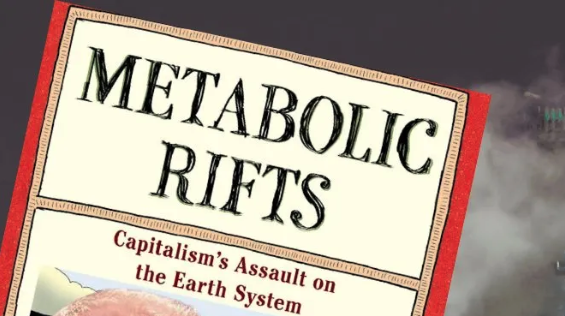
Martin Empson, author of Socialism or Extinction, asked me four questions about my new book, Metabolic Rifts: Capitalism’s Assault on the Earth System (Monthly Review Press, 2026). Here are his questions and my answers. A lightly edited version was published in Socialist Worker on May 17.
Your new book is centred on the multiple environmental crises caused by capitalism. How bad is it?
For nearly 12,000 years, since the last Ice Age, conditions on Earth have been favorable for human development, enabling the invention of agriculture and the growth of large, complex societies. Today environmental change, driven by capitalism’s inexorable drive to expand at all costs, is undermining those conditions. Like an autoimmune disease that attacks the body it dwells in, capitalism is tearing apart the very planet that feeds it.
Scientists have identified nine environmental conditions that define a “safe operating space for humanity.” The warming caused by greenhouse gas emissions, the acidification of the oceans, the extinction of plant and animal species, and others — limits on these and other changes must be respected to maintain a habitable Earth.
Eight of the nine boundaries have already been breached. There is serious concern that violating any one of them, or a combination, could lead to a tipping point from which there would be no possible return.
The global situation is bad and rapidly getting worse. changes are happening much faster than scientists predicted a decade ago, and the impact is felt most severely by the world’s poorest people, those who have done the least to cause the crisis.
If nothing is done soon, substantial parts of the globe will be uninhabitable, and life on the entire planet will be very difficult indeed.
At the heart of your analysis is Karl Marx’s “metabolic rift” theory. Can you explain its relevance for activists today?
Metabolic rift theory provides an essential framework for understanding environmental crises. It shows how and why capitalism is engaged in an unceasing war against nature.
Life and the environmental conditions that sustain life depend on metabolic cycles, in which essential materials are constantly recycled. For example, through natural processes, including the breath of plants and animals, our planet emits and absorbs over 350 billion tons of carbon dioxide every year.
For millions of years, emission and absorption have been roughly balanced, The carbon cycle makes life on earth possible, by constantly circulating and reusing the matter and energy that life requires.
Capitalism, in contrast, is linear — any part of production that doesn’t contribute to profit is discarded, not recycled. As the Marxist philosopher Istvan Meszaros wrote, “The measure of advancement of advanced capitalism [is] … the efficacy with which waste can be generated and dissipated on a monumental scale.”
Most notably, capital’s dependence on fossil fuels produces carbon dioxide as waste, far more than natural processes can absorb, so it is building up in the atmosphere and the ocean, causing global warming and reducing the nutrient levels in major food crops.
There is a massive rift in the carbon cycle, caused by capitalism’s inability to produce without generating ever more pollution.
As I’ve tried to show in my book, the concept of metabolic rifts gives us tools for understanding the causes of environmental degradation and provides guidance on how our global crises can be solved.
You follow Marx and Engels in using the latest scientific research in extending the Marxist analysis of the relationship between humans and nature. How are scientists responding to environmental crisis?
The first thing to note, of course, is that there is no significant scientific disagreement about the growing climate crisis. No credible scientist denies that global warming is real and that the cause is greenhouse gas emissions produced by industry and agriculture. The science is as certain as anything we know how about the Earth System.
Scientists have been very active in pressing for action to reduce emissions rapidly, warning the failure to do so could have catastrophic results. Many now warn that failing to change may lead to unstoppable climate change, no matter what action we take.
What’s missing from most scientific proposals, however, is a clear vision of the political and social changes that must be made. There are exceptions — for example, climatologist Kate Marvel, who recently resigned from NASA in protest against Trump’s attacks on climate science, has written that we need a world “where the power to make decisions about the climate is invested in the people, not corporations or billionaires.”
We can hope that she and other scientists will help to build a movement with that end in view. The eco socialist left, in my view, needs to put strong efforts into winning scientists to radical conclusions.
You argue that revolution will not see the immediate end of the crisis, but the beginning. How might that look?
The founders of the socialist movement were reluctant to predict what the transition to socialism might be like. As Karl Marx famously said, he didn’t want to write cookbooks for the chefs of the future. We don’t know what the exact circumstances will be, so we can’t provide detailed instructions.
But we do know that any new society will inherit a severely damaged planet. Many of the changes are already irreversible—for example, there is no way to stop glaciers and ice sheets from melting, which means that the oceans will rise and coastal cities will eventually be submerged.
If capitalism’s destructive operations continue for much longer, there will be many such problems to address, and repairing the damage will take decades, even under the most favorable conditions.
The German socialist Walter Benjamin famously wrote that a real revolution means grabbing the emergency brake, to stop capitalism from driving humanity’s train to disaster. The primary activity of a revolutionary society, then, must be to reroute the train, to an ecologically sound destination.
[Metabolic Rifts: Capitalism’s Assault on the Earth System is available now from these online booksellers: books2read.com/Metabolic-Rifts.]