Tag: Democracy

popED: Dinga Sikwebu

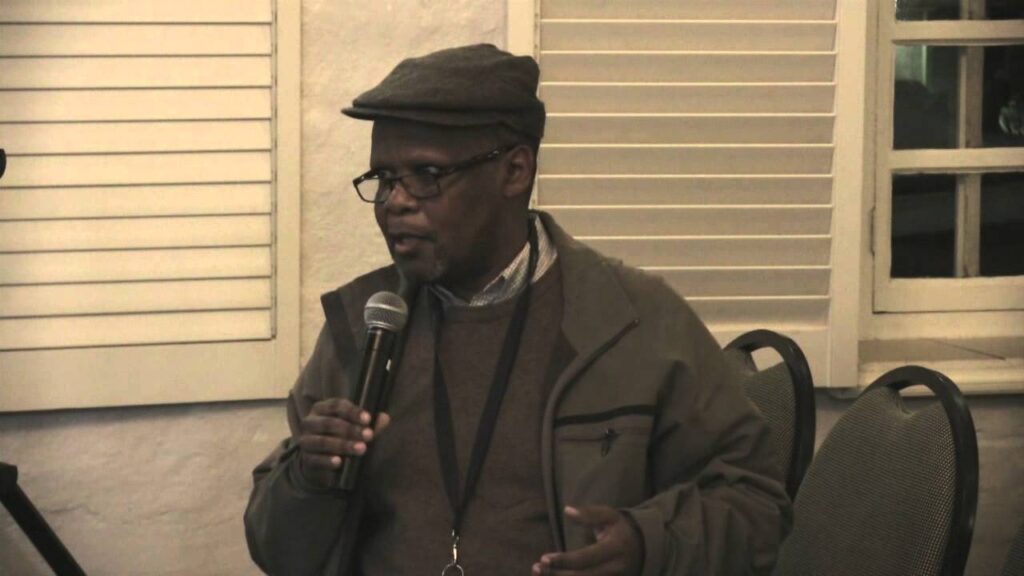
When the left confronts a political crisis, the answer is often the same: form another political party. Veteran trade unionist and political educator Dinga Sikwebu has a name for this obsession: party mania. Drawing on his experience in NUMSA and the United Front, Dinga asks whether the constant search for a new electoral vehicle has […]

The Biko Inquest: ‘We carry our history with us’

THE ROAD FROM LIBERATION TO DISILLUSIONMENT Reflecting on detention during apartheid and Steve Biko’s enduring influence, Ashwin Desai connects the past to anxieties about corruption, political radicalism and South Africa’s democratic future. ‘Our pains will petrify when our gestures no longer make sense. But our tears, brother, who will take them on himself?’  – (Edmond […]

Violence at Che Guevara Road: March and March and eThekwini Municipality must account for Section 4 permits on 3rd and 4th September 2026

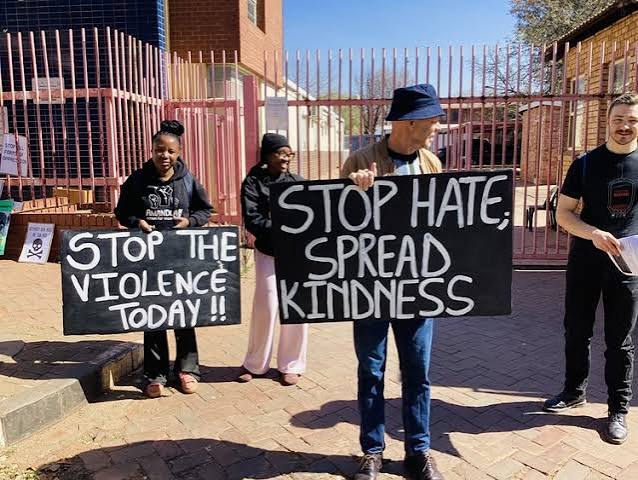
On the 3rd of September 2026, members of the March and March movement crossed Che Guevara Road in Umbilo, Durban, and directly confronted a community of documented refugees and asylum seekers who have been sheltering on the pavement outside the Department of Home Affairs Refugee Reception Office for approximately three months. What followed was hours […]

From xenophobia to authoritarian politics

This year marks 50 years since the 1976 youth uprising, a turning point in South Africa’s struggle against apartheid. While triggered by the introduction of Afrikaans as the medium of instruction in schools, it would result in the creation of a new social force that birthed new movements of resistance and emancipatory politics. The anniversary serves as […]

INPUT BY SAFTU GENERAL SECRETARY ZWELINZIMA VAVI AT THE NATIONAL DEMOCRATIC REVOLUTION SEMINAR

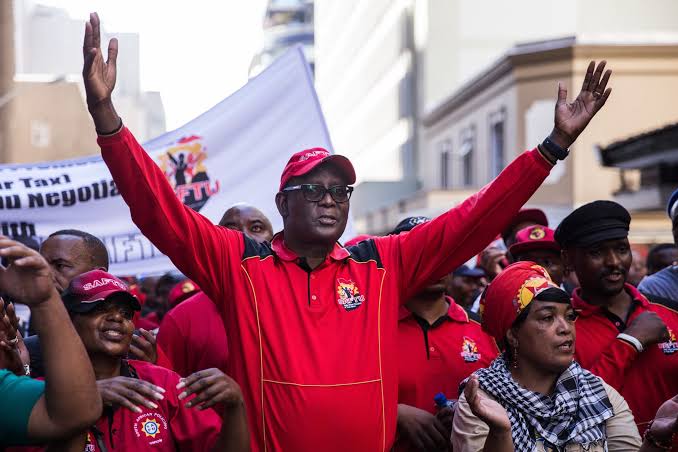
THIRTY-TWO YEARS OF DEMOCRACY: A WORKING-CLASS ASSESSMENT OF THE NATIONAL DEMOCRATIC REVOLUTION Comrades, colleagues, leaders of the movement, intellectuals, veterans of the struggle, and fellow South Africans,I must begin by locating myself.I am not speaking here as a neutral observer.I am not speaking as an academic standing outside the battle.I speak as a trade unionist.I […]

When Movements Become Cults

When Desperation Produces Strongmen Why “Messianic” leaders always turn against workers A SAFTU Political Education Pamphlet Why do Strongmen rise? Strongmen do not rise because societies are “stupid”. They rise because societies are desperately trying to find a way out of a deep crisis. They emerge when people experience: In these moments, people start saying: […]

The death of politics in South Africa.

We are underestimating the devastating impact of the death of politics in South Africa. Not politics as elections, conferences or speeches, but politics as the conscious, organised participation of ordinary people in shaping their collective future. We have never honestly analysed how the “big man” phenomenon hollowed out our democratic culture. The towering moral authority […]

The SACP and Neoliberalism

Dennis Davis and Karl Klare argue that transformative constitutionalism has not been fully pursued by the African National Congress (ANC). As the governing party between 1994 and 2024, it was in poll position to use the powers of state to give effect to and operationalise the imaginary that the 1996 Constitution presents. This imaginary, they argue, provided for a thorough transformation of the state that would have overturned the legacies of colonialism and apartheid and paved the way for the actualisation of the full human potential of particularly black people, women, poor people, and sexual minorities. Rather than it being, as anti-constitutionalist detractors would have it, a failure of the Constitution to address the urgent colonial and apartheid legacies impacting these groups, Davis and Klare contend that it is a failure of politics that has left specifically economic relations unchanged. I concur with this argument, based on my own previous analysis (Van der Westhuizen et al. 2023; Van der Westhuizen 2007). This failure of politics becomes apparent with the necessary historicisation —that is, when the actual conditions and relevant political and ideological factors and actions informing the transition to democracy are studied. Such historicisation makes a nonsense of claims that South Africa’s constitutional democracy amounts to mere neo-apartheid (see for example Mpofu-Walsh 2021). I would add to the diagnosis of a failure of politics the failure of political imagination, due in part to what can be described as post-socialist attachments. The concept of ‘post-socialism’ is derived from analyses of the crisis-ridden incorporation of the former Soviet Bloc into the capitalist world order, and is used here with reference to the legacies of ANC exposure to Soviet political practices during the exile period (Engel and Saunders 2023; Kalb 2019). While exiled members of the ANC and its ally the South African Community Party (SACP) generally possessed little knowledge about Soviet economic planning and institutions (Freund 2013, p. 520), they did return to South Africa with political ideas influenced more by party-driven centralisation of political control than by democracy — therefore influenced by an imaginary of so-called ‘revolutionary discipline’ that Stephen Ellis (2012, p. 298) describes as involving ‘contempt for real politics’.
1 2

SEARCH

© Zabalaza for Socialism 2025. Designed and Developed by BrightQuill