Tag: Rights

Zionism, anti-Semitism and eugenics

The conflation of the religio-nationalist ideology of Zionism not only with Judaism and the nation state of Israel, but also with antisemitism, continues to be widely promoted. Yet the terminology and the manner of its use grew out of the pseudoscientific racism that flourished in the 19th Century. This came in response to the humanist […]

Zabalaza for Socialism: New Year Message for 2026

Another world is not only possible — it is necessary and urgent We enter a new year in a time of deep crisis and danger. In South Africa, the state under the Government Of National Unity dominated by the ANC continues to fail and collapse. Basic services are crumbling, corruption and patronage flourish, unemployment and […]

Press Statement: CWAO opposes the new NEDLAC Amendment Act, 2025 – here’s why

The new NEDLAC Amendment Bill strengthens an elitist, unaccountable institution that has consistently served capital’s interests. The working class should fight for NEDLAC to be closed down instead. Casual Workers’ Advice Office Press Statement1 December 2025 at 1pm Contact person: CWAO Researcher, Sydney Moshoaliba on 072 509 3587 CWAO opposes the new NEDLAC Amendment Act, […]

On Mamdani and the Invention of Foreigners

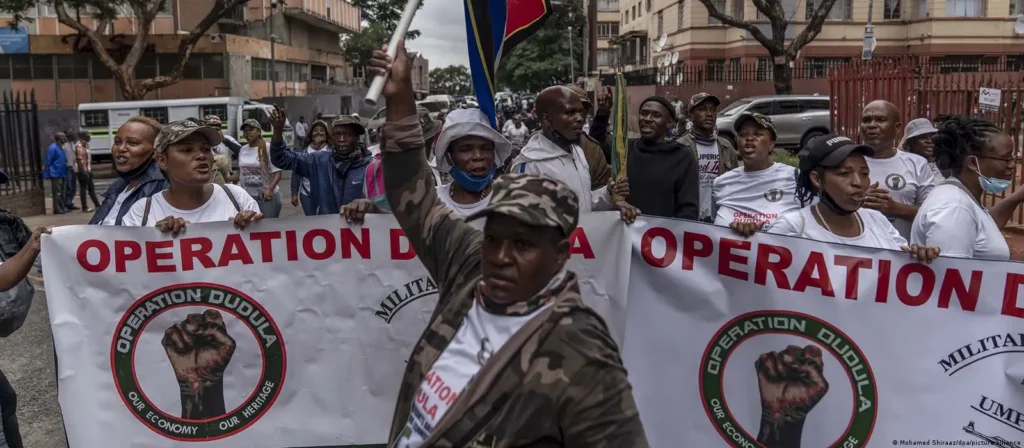
DEK:  From indirect rule to Operation Dudula, the lines dividing citizen from stranger trace back to the way empire organized identity and labor. There’s no shortage of analysis when it comes to xenophobia in South Africa. We’ve heard it explained as the outcome of deep structural inequality, the failure of post-apartheid redistribution, or the slow-burning crisis […]

Behind the Youth Revolt

The number of mostly spontaneous mass protests in Africa has grown exponentially since the start of the 2010s and yet, it still has not registered in many decisionmakers’ minds that a sea change is afoot in our political economy. Africa has the youngest population in the world. A rapid acceleration of quality service delivery is required to make Africans unite behind some kind of social contract and yet, nowhere is there any sign of the urgency that is required. This explains the growing anger that wee see in the population. 

GIWUSA to Demand Mining Nationalisation and Justice for Stilfontein in Submission to Human Rights Inquiry

JOHANNESBURG, SOUTH AFRICA – 1 October 2025 – The General Industries Workers Union of South Africa (GIWUSA) will tomorrow formally present its comprehensive submission to the South African Human Rights Commission (SAHRC) National Inquiry into artisanal mining and Operation Vala Umgodi. The union will present a radical worker-led program that demands justice for the Stilfontein tragedy, the nationalisation of the mining industry, and massive public investment to eliminate unemployment.

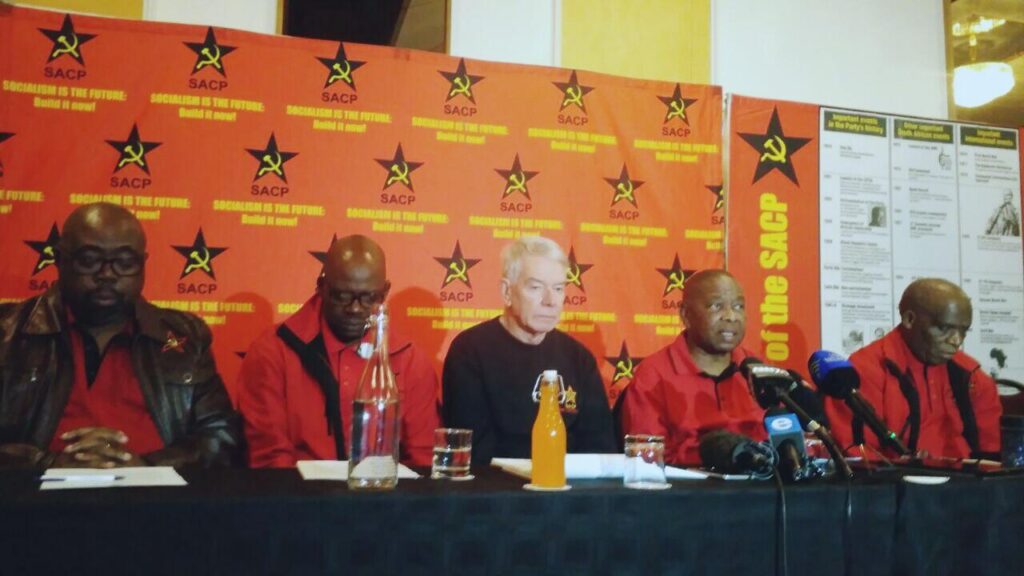
The SACP and Neoliberalism

Dennis Davis and Karl Klare argue that transformative constitutionalism has not been fully pursued by the African National Congress (ANC). As the governing party between 1994 and 2024, it was in poll position to use the powers of state to give effect to and operationalise the imaginary that the 1996 Constitution presents. This imaginary, they argue, provided for a thorough transformation of the state that would have overturned the legacies of colonialism and apartheid and paved the way for the actualisation of the full human potential of particularly black people, women, poor people, and sexual minorities. Rather than it being, as anti-constitutionalist detractors would have it, a failure of the Constitution to address the urgent colonial and apartheid legacies impacting these groups, Davis and Klare contend that it is a failure of politics that has left specifically economic relations unchanged. I concur with this argument, based on my own previous analysis (Van der Westhuizen et al. 2023; Van der Westhuizen 2007). This failure of politics becomes apparent with the necessary historicisation —that is, when the actual conditions and relevant political and ideological factors and actions informing the transition to democracy are studied. Such historicisation makes a nonsense of claims that South Africa’s constitutional democracy amounts to mere neo-apartheid (see for example Mpofu-Walsh 2021). I would add to the diagnosis of a failure of politics the failure of political imagination, due in part to what can be described as post-socialist attachments. The concept of ‘post-socialism’ is derived from analyses of the crisis-ridden incorporation of the former Soviet Bloc into the capitalist world order, and is used here with reference to the legacies of ANC exposure to Soviet political practices during the exile period (Engel and Saunders 2023; Kalb 2019). While exiled members of the ANC and its ally the South African Community Party (SACP) generally possessed little knowledge about Soviet economic planning and institutions (Freund 2013, p. 520), they did return to South Africa with political ideas influenced more by party-driven centralisation of political control than by democracy — therefore influenced by an imaginary of so-called ‘revolutionary discipline’ that Stephen Ellis (2012, p. 298) describes as involving ‘contempt for real politics’.

1 2 3 4

SEARCH

© Zabalaza for Socialism 2025. Designed and Developed by BrightQuill