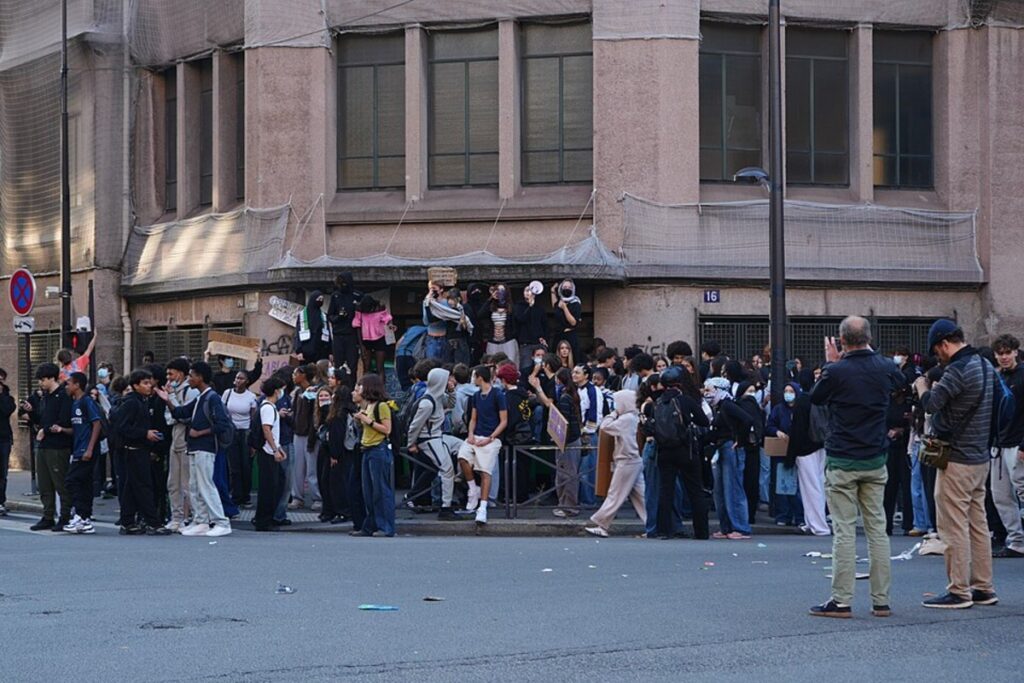
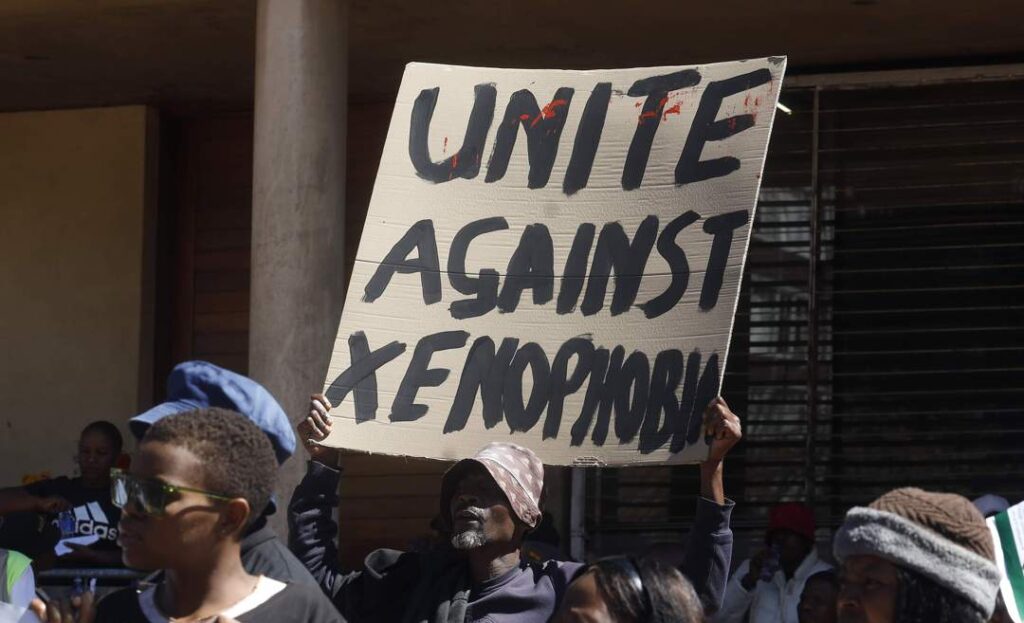
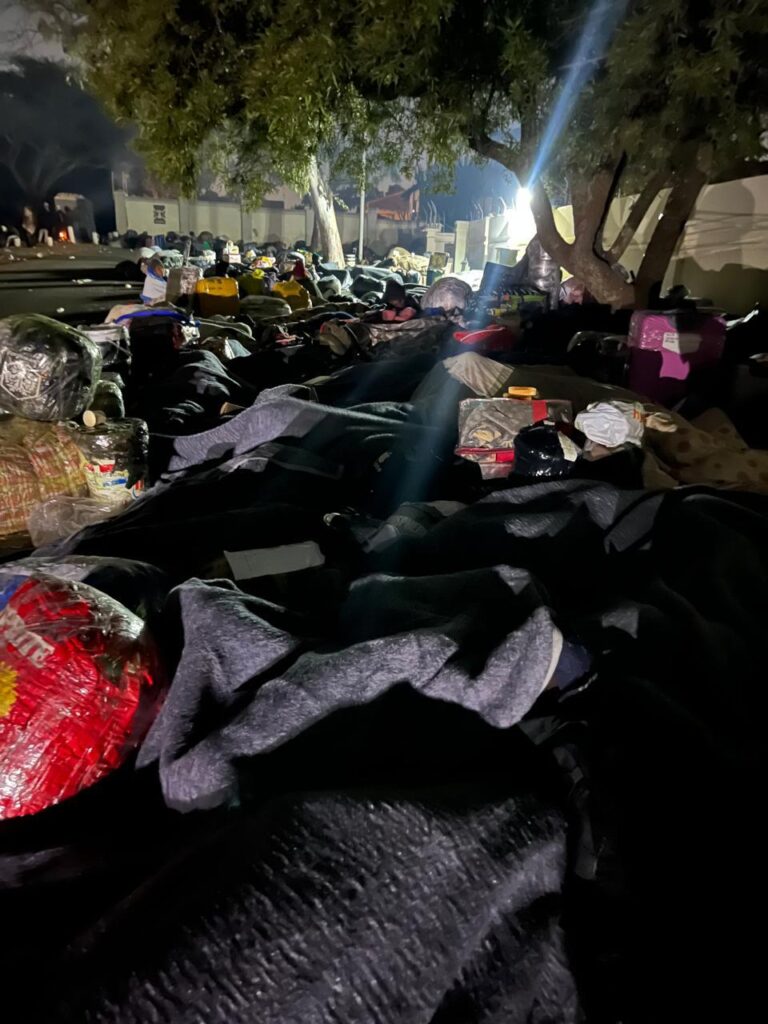
500 Migrants outside the Malawian consulate Woodmead, Johannesburg
In townships and informal settlements across South Africa, violence against foreign nationals is no longer episodic. It is increasingly organised and spoken about in ways that normalise it. Groups such as March and March have become associated with mobilisation that targets migrants in the name of jobs, safety and service delivery. In some areas, these dynamics intersect with the political language and support base of the uMkhonto weSizwe Party (MKP), which has amplified narratives of national grievance in ways that blur the line between legitimate anger at state failure and the scapegoating of migrants.
In many communities, this has created a climate of fear. Migrant workers and traders are forced to flee informal settlements during waves of intimidation. Violence is often carried out by loosely organised groups, sometimes described locally as amabutho or vigilante formations, operating in the space opened up by weak policing, collapsing municipal authority and deepening social desperation. The result is that sections of the working class are being turned against one another while the structural causes of their suffering remain untouched.
It is important to be precise about who is most affected. Xenophobic violence does not target migrants as an abstract category, but often the most vulnerable sections of the working class: migrants living in informal settlements, precarious workers, domestic workers, informal traders and poor South Africans living under the same conditions of insecurity and state neglect. The politics of scapegoating works by turning people who share the same struggles against one another, obscuring the deeper causes of poverty, unemployment and exclusion.
The central political question is not whether the current wave of xenophobic violence exists or whether it is spontaneous. It is how it is being organised, who is enabling it, and how it can be stopped. What we are witnessing is a convergence of crises: economic collapse, state incapacity, political fragmentation and an increasingly volatile public discourse in which migrants are presented as the explanation for South Africa’s failures. At the level of lived experience, this produces real violence. At the level of politics, it redirects legitimate social frustration away from the state, capital, corruption and inequality.
Official state discourse has increasingly adopted elements of the same framing that fuels xenophobic sentiment, with migration treated as a primary site of crisis rather than as a consequence of deeper structural conditions. The ANC has at times foregrounded migration in ways that obscure unemployment and economic restructuring. Meanwhile, elite political networks, ranging from domestic business figures such as Johann Rupert to global actors who shape political discourse elsewhere, form part of a broader ideological environment in which inequality is depoliticised and re-explained through cultural or national categories rather than class relations.
The Rise of Reactionary Nationalism and the Battle for Township Politics
In this context, some communities are experiencing the rise of a more volatile and ethnically coded mobilisation, where insecurity and social frustration are channeled into broader narratives of exclusionary nationalism. There is a real danger that township politics becomes dominated by a logic of exclusion – a “voracious tiger” of reactionary nationalism feeding on desperation and fear, threatening to devour the possibility of working-class unity. Tens of thousands of African migrants are already being displaced or forced into hiding during outbreaks of intimidation and violence.
The result is a political vacuum in which social discontent circulates without class direction.
It is in this vacuum that organisations such as March and March, Operation Dudula, alongside elements within or adjacent to MKP-aligned mobilisation, gain influence. This does not mean these formations are reducible to xenophobia, nor that they are monolithic. But it does mean that their politics often intersect with narratives that legitimise Zulu nationalism and other forms of ethnic exclusion, directing popular frustration towards migrants rather than the conditions that produce unemployment and insecurity.
The digital sphere intensifies these dynamics. While sections of the mainstream media can legitimise groups such as March to March by portraying them as conventional civil society actors rather than critically interrogating their exclusionary politics, social media platforms accelerate the circulation of xenophobic narratives by rewarding outrage, fear and emotional intensity. These narratives thrive within an attention economy that monetises engagement, polarisation and social division. Against this background, the socialist left confronts an urgent strategic task: how can this cycle of scapegoating and violence be broken? We ask ourselves: Where is the organised power capable of breaking this cycle?
This debate has become more pressing as the organised left seeks to regroup. The SACP’s Conference of the Left and the subsequent formation of the Council of the Left were attempts to respond to fragmentation among progressive forces. The intention, to rebuild coordination among organisations claiming to represent working-class interests, is understandable.
But unity is not self-evident. It must be defined politically.
The inclusion of diverse political formations within these processes, including the MKP, raises a fundamental strategic dilemma: what kind of unity is being constructed, and on what political basis? Can meaningful left unity be built without clearly confronting xenophobia and nationalist scapegoating? Or does the attempt to broaden alliances risk weakening the political distinctions required to defend working-class internationalism?
These are not abstract debates. They go to the heart of socialist strategy.
There is still time to choose a different path. If the Conference of the Left and Council of the Left are serious about rebuilding working-class unity, they should place the struggle against xenophobia at the centre of their practice—not as a secondary issue, but as an immediate organising priority. They should bring their forces into the anti-xenophobia coalitions already being built in communities and workplaces alongside formations such as Siyafana Sonke, SAFTU affiliates, Abahlali baseMjondolo and others defending migrants under attack.
The decision by Zabalaza for Socialism (ZASO) not to participate in the Conference of the Left because of the inclusion of organisations associated with xenophobic politics should not simply be dismissed. It should be understood as a warning that unity without political clarity risks becoming unity without purpose. The task is not to deepen divisions on the left, but to forge unity through common struggle against xenophobia, racism and capitalist exploitation.
From Shield to Sword: Building Working-Class Power Against Xenophobia
Marxist debates over the united front emerged when the working class faced existential threats from rising reactionary movements, particularly fascism in Europe. The united front was developed as a method through which independent working-class organisations could coordinate action while maintaining political independence. Its principle was straightforward:
March separately, strike together.
The aim was to strengthen the self-activity of the working class—not replace it with agreements among leaderships.
The popular front represented a different approach, prioritising broad political alliances that included forces with divergent or opposing class interests. Marxist critics argued that such alliances could subordinate working-class independence to broader coalitions where class clarity was weakened. The experiences of France and Spain in the 1930s are not direct analogies to South Africa, but they remain reminders that unity can either strengthen working-class capacity or dilute it.
In South Africa, this tension is visible in the gap between political regroupment at the level of organisations and the fragmentation of working-class life on the ground.
It is precisely here that emergent debates within Siyafana Sonke point to another orientation. The June 15th founding statement of Siyafana Sonke begins from the immediate necessity of building a shield against xenophobic violence: defending communities under attack, protecting migrants and creating a united response against intimidation and exclusion. This humanitarian dimension has been essential. Across the country, from Durban to Cape Town to Johannesburg, ordinary people, including many from the middle class, have stood in solidarity with migrants, sometimes placing their own bodies between vulnerable communities and those seeking to inflict violence. Organisations such as Gift of the Givers have also played a critical role in responding to the humanitarian consequences of these attacks. These acts of courage and solidarity matter, particularly at a moment when fear and reactionary politics are gaining ground.
But a shield alone cannot defeat the forces producing this crisis. As the Siyafana Sonke founding statement argues, while we build the shield, we must also craft the sword. The sword is not violence; it is organised collective power: the capacity of communities to challenge the economic and political conditions that allow xenophobia to flourish. A humanitarian response can protect people from immediate harm, but it cannot by itself transform the conditions of unemployment, insecurity, inequality and state abandonment that create the terrain on which scapegoating grows.
The challenge therefore is to move from defence towards organisation. Siyafana Sonke therefore must not only oppose formations such as March and March, but help build progressive popular power in communities themselves. This means supporting communities to organise meetings, develop democratic structures, identify their own priorities and collectively challenge both state and private power. The task is to move beyond repeatedly responding to crises after they erupt and instead build united fronts in townships and informal settlements capable of defending communities before violence occurs.
This is not an easy task. The fragmentation and decline of civic organisations, unions and working-class formations has created a vacuum in many communities. But the left is not starting from nothing. There are roots of organisation in dozens of communities across the country. The task is to rebuild from these existing struggles: through community meetings, workplace organisation and alliances between residents, migrants, unions and social movements. As representatives from formations such as Thembelihle Crisis Committee and Abahlali baseFreedom Park (Soweto) have argued, the starting point must be organising community by community, building the democratic capacity necessary to confront both xenophobic mobilisation and the deeper structures that sustain inequality.
The fight against xenophobia cannot be separated from rebuilding working-class organisation. Migrants are not the cause of unemployment or state failure. They are part of the same class whose fragmentation is being exploited. Where workers organise together – South African and migrant alike – the appeal of scapegoating weakens in practice.
This presents an urgent challenge for organised working-class formations, including SAFTU and other labour and civic organisations:whether they can respond to this moment by rebuilding united fronts from below. The question is not only how to defend communities under attack today, but how to build the collective power capable of preventing these attacks from becoming normalised.
Fragmented responses are no longer sufficient.
The task is therefore not only defensive, but constructive. It is to rebuild the capacity of the working class to act collectively across national divisions. That means rebuilding unions, civics, social movements and community organisations capable of sustained struggle. It means naming the real sources of crisis: unemployment produced by capitalist restructuring, inequality produced by accumulation, and political decay produced by elite capture and institutional failure.
Only such a movement can reverse the logic of scapegoating.
The central issue confronting the South African left is not whether unity is necessary. It is what kind of unity can defeat xenophobia rather than accommodate it.
A unity built through political aggregation alone will not be enough. What is required is a united front rooted in working-class self-activity—one capable not only of defending migrants under attack, but of rebuilding solidarity in every workplace, settlement and community.
That work cannot wait for another conference or declaration. It begins wherever workers organise together across nationality, language and ethnicity against exploitation, dispossession and fear.
Rehad Desai is a leading member of ZASO and is mandated to represent the organisation inside Siyafana Sonke Action Campaign
Luke Sinwell is a leading member of Siyafana Sonke Action Campaign
Both are based in Gauteng and attached to the University of Johannesburg