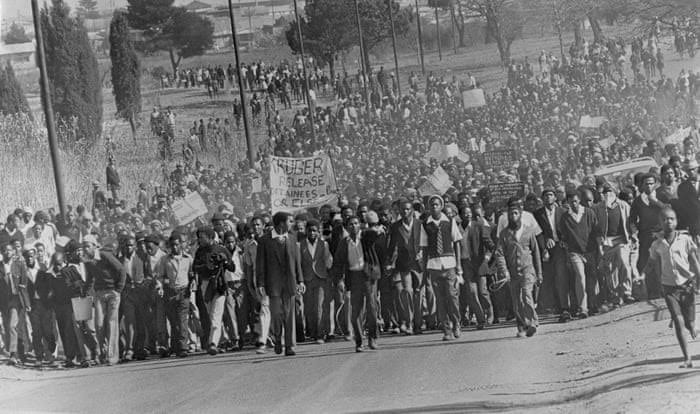
On 30 June 2026, a few hundred people marched through Soweto as part of the broader campaign of xenophobia that in recent weeks has swept across some parts of the country. In the same month, the country marked the 50th anniversary of the historic 1976 uprising, when tens of thousands of Black students nationally mobilised against Bantu Education and apartheid.
The current wave of anti-immigrant violence, led and supported by right-wing and ethno-nationalist groups, stands in sharp contrast to the emancipatory politics of the 1976 generation.
Forging Black unity against apartheid’s divisions
Enforcing racial and ethnic divisions was one of the cornerstones of the apartheid system. From the 1950s the government promulgated a battery of laws to entrench divisions among Black people in order to preserve white minority rule. The Black Consciousness Movement rejected the ideological premise and manifestations of these divisions and, crucially, sought to forge Black unity as a means to achieve liberation.
From its founding in 1969, the South African Students’ Organisation (SASO) mobilised Black university students across the country to challenge the racial and ethnic divisions of both the so-called ‘bush’ and the predominantly white universities. In September 1974, it organised ‘Viva Frelimo’ rallies to celebrate Mozambique’s freedom and to reaffirm that the struggle against apartheid in South Africa was inextricably connected to the anti-colonial struggle across our continent.
This tradition of Pan African solidarity is now being trampled on by March and March’s afrophobic pogroms.
In 1976 the South African Students’ Movement, together with local student leaders in Soweto, established the Action Committee and later the Soweto Student Representative Council (SSRC). These township-wide structures co-ordinated campaigns first against the imposition of Afrikaans as a medium of instruction and, thereafter, to oppose a wave of state violence. Their existence and politics were explicit denunciations of the state’s ethnic divisions of schools in the township.
The eruption of protests in June of that year also revealed an emerging solidarity between students in the racially segregated areas of Soweto, Lenasia and Noordgesig/Coronationville. Similar nascent solidarity also developed among protesting students in the Western Cape, which would become especially significant during the 1980s school boycotts.
Unity between students and workers
At its founding in early August 1976, the SSRC acknowledged the importance of creating unity between students and parents/workers in order to maximise the power of the oppressed against the state and capital. It recognised that the deteriorating living conditions in townships, including serious overcrowding, poor education and low wages, were caused by the same system. Sibongile Mkhabela (née Mthembu), a prominent student leader, has recalled the SSRC’s political stand:
In order to hit the economy, we appealed to our working and toiling masses to join students in an assault on the “system”, in this instance the captains of industry and a government which enabled them to accumulate ill-gotten wealth at the expense of our parents – the slave wage earners.
Following a successful stayaway (Azikhwelwa) on 4 August, the SSRC called for a second stayaway for 23 to 25 August. Activists spent the next two weeks meeting students at schools and visiting workers at their homes to mobilise support for the planned action. As a result, approximately 75 per cent of Johannesburg’s African workforce heeded the call on 23 August, making it the largest strike in the city since the early 1960s.
The success of this stayaway was, however, marred by conflict between students and hostel dwellers. The latter group was apparently not consulted and therefore did not join the action, causing students to perceive them as strike-breakers. In the afternoon, groups of students confronted hostel dwellers on their way back from work, which led to a violent clash. An attempt to burn down the Mzimhlope hostel caused tensions to rise sharply, which the SSRC quickly condemned.
Countering state-sponsored division
At this point the sinister hand of the state appeared as the police, supported by the state-aligned Urban Bantu Council (UBC), orchestrated attacks by hostel dwellers on the township. According to a journalist, the Soweto police commander, General Gert Prinsloo, organised a meeting of hostel dwellers at Mzimhlope, where he handed out food and told them to ‘Eat, so that when you kill you are full.’ He instructed the assembled group to kill ‘troublemakers’ (meaning students) but to not damage apartheid infrastructure.
Over a period of two weeks, dozens of people were killed, leading the newspaper, The World, to warn that ‘anarchy is threatening to engulf townships in Soweto, with black fighting black residents.’
Deep divisions between township residents and hostel dwellers seemed firmly entrenched. For the state, the intra-township violence served both to support its objective of divide-and-rule and to strike deadly blows against student activists. These events were also harbingers of the 1980s, when the apartheid state mobilised vigilante groups to destabilise communities and anti-apartheid organisations.
At the height of the violence in August 1976, the SSRC proved its political and strategic mettle. Together with adult leaders, mainly the Black Parents’ Association, it made serious efforts to overcome the divisions among sectors of the Black community. Within days of the eruption of attacks on township residents, the student body distributed a pamphlet that contained a strident critique of the migrant labour system, bantustans and the degrading conditions in the hostels:
The students have nothing against people living in the hostels, they are our parents, they are victims of the notorious migrant labour system. They are forced to live hundreds of miles away from their families, their needs and grievances are ignored by the powers that be. WE are aware that they are packed like sardines in small rooms with no privacy and living under appalling conditions. Yet when the students rise against these injustices and designers of our miserable lives, the powers that be suddenly realise that these are well meaning citizens. The puppet UBC, acting on instruction from Pretoria, deems it fit to arm our parents in the hostel against us. The students reject, in toto, the entire oppressive system with its largely pocket institutions like the UBC’s and the Bantustans, those toy telephones are designed to divide the Black community. United we stand.
By making common cause with the hostel dwellers as parents and workers, the SSRC demonstrated their empathy with their daily humiliation in overcrowded, single-sex dormitories. It also exposed the state’s opportunism in stoking violence in the township. In early September, the SSRC issued a pamphlet directed at hostel dwellers with very clear political message: it railed against the state’s strategy of using ethnicity to divide black people and appealed for black unity against a common enemy:
1. Remember you are all blacks: Whether you are Zulu, Mosotho, Mopedi, Xosa, Motswana, Venda, etc. You are one: sons and daughters of the black cradle.
2. You will not kill your black brother, father, mother, son or daughter: Stop fighting among yourselves. Stop killing each other while the enemy is strong.
3. Do not allow yourself to be divided: Be united to face the common enemy: Apartheid, Exploitation and Oppression. Unity is strength! Solidarity is power!
4. Beware of false leaders: They will always run in the dark to Jimmy Kruger to sell out the true Sons and Daughters of the Black nations. They are tools and stooges of the oppressive system.
5. Beware of Political Opportunists: Who will always agitate Black people for their own end. They are cowards who cannot face the enemy by themselves. They want to use us. They will always spread false rumours in the name of the students.
6. We say to all black students, residents and hostel inmates: You know your true leaders. Listen to your leaders. Support your leaders. Follow your leaders.
Drawing on the politics of Black Consciousness, the student leadership rejected apartheid’s project of ethnic divisions, which were especially visible in the hostels. Counterposed to the state’s divide-and-rule strategy, the SSRC worked hard to involve hostel dwellers in its plans for a third stayaway from 13 to 15 September. This shift in tactics yielded positive results and, in sharp contrast to the August events, migrant workers supported the stayaway in large numbers.
The generation of 1976 recognised that the state and capital, with the support of conservative forces, would foment violence in order to undermine Black unity. By striking fear into poor communities and unleashing violence against progressive movements, the apartheid state and its allies hoped to weaken the mounting struggle against apartheid.
Forging unity today
Today, similar processes are unfolding in a context of deepening crisis in the country. Those who wield power are determined to undermine the possibility of unity of the poor Black majority against the system responsible for unprecedented levels of poverty, homelessness, unemployment, hunger and violence. Xenophobia, ethno-nationalism and racism are being mobilised to scapegoat those defined as ‘others’ and not belonging here (e.g. South Africa, KwaZulu Natal, Western Cape) as the causes of our problems. The result, as The World warned 50 years ago, will be anarchy and increasing violence against and among poor black people. The main beneficiaries of such chaos will be those who support and are enriched by the status quo.
An alternative is possible, as demonstrated by the students who shook apartheid to its core. The SSRC named the common enemy: ‘Apartheid, Exploitation and Oppression’. In other words, the system of racial capitalism. Crucially, it worked to create maximum unity of the Black oppressed against this system. In confronting the rising tide of right-wing politics, of which xenophobia is an urgent and dangerous threat, we can learn important lessons from the generation of 1976. The unity of the poor majority – students, workers, unemployed, women – can challenge and overcome the system that produces austerity, corruption, state failure, water and electricity shortages, low wages, overcrowding and gender-based violence.