
Cyril Ramaphosa and the Democratic Alliance (DA)—the two dominant forces within South Africa’s newly formed Government of National Unity (GNU)—have converged on a singular narrative: economic growth is the key to undoing centuries of apartheid colonial inequality. This mantra has become the cornerstone of the GNU’s public rhetoric and policy direction. Ramaphosa in particular has championed reforms under Operation Vulindlela, presenting it as a blueprint for accelerating inclusive economic expansion.
While we can agree in principle that economic growth has the potential to address inequality, and that interventions like Operation Vulindlela may improve state efficiency and modernise administrative bottlenecks, we must reject the flawed premise that economic growth will be achieved simply by making it easier for large-scale corporations to extract profit. This notion—disguised as pragmatism—effectively entrenches historical power structures while sidelining grassroots development.
Yes, corporate investment has a role to play in economic development. But unless growth is coupled with meaningful wealth redistribution and genuine community participation, it will reproduce the very inequalities it claims to resolve. Operation Vulindlela, in its current form, is not designed to enable bottom-up economic transformation. Its focus on systemic, sectoral reforms rests on the belief that improved administrative efficiency will trickle down into job creation and development. Yet this model, if left unchecked, risks perpetuating a growth illusion: one that modernises the economy without humanising it.
A Case in Point: The Mining Sector
The mining sector is a perfect example of how this model plays out. It is one of South Africa’s most profitable and politically prioritised sectors. Thanks to the efforts under Operation Vulindlela, mining companies have been granted faster access to licenses, streamlined regulatory approvals, and greater certainty around water use rights. These reforms have undeniably made it easier for corporate mining interests to operate and profit.
But what has this meant for the communities living next to the mines? Very little.
To illustrate, we turn to the following graph that juxtaposes mining sector profitability against employment from 1984 to 2025:
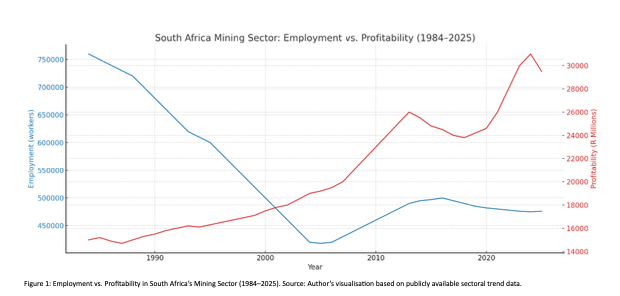
[Graph 1: South Africa Mining Sector: Employment vs. Profitability (1984–2025)]
Figure 1: Employment vs. Profitability in South Africa’s Mining Sector (1984–2025). Source: Author’s visualisation based on publicly available sectoral trend data.
This image reveals a critical truth: as profits (red line) have climbed, especially in the last two decades, employment (blue line) has steadily declined or plateaued. There has been no meaningful reinvestment into the communities most affected. In fact, the ability to generate profit appears inversely related to the sector’s contribution to job creation and local development.
In tandem, another telling visual underscores this exclusion:
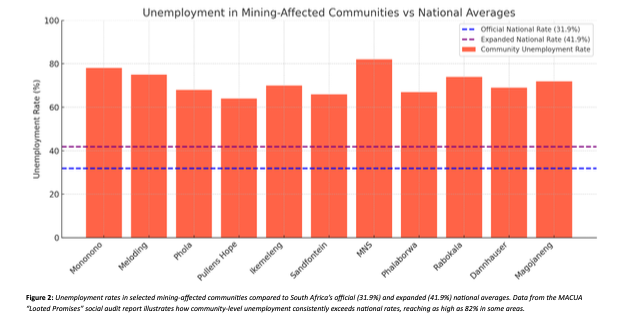
[Graph 2: Unemployment in Mining-Affected Communities vs National Averages]
Figure 2: Unemployment rates in selected mining-affected communities compared to South Africa’s official (31.9%) and expanded (41.9%) national averages. Data from the MACUA “Looted Promises” social audit report illustrates how community-level unemployment consistently exceeds national rates, reaching as high as 82% in some areas.
Here, we see how community-level unemployment in mining regions far surpasses even South Africa’s dire national averages—reaching levels of 65% to 82% in some areas, compared to the official national rate of 31.9% and expanded rate of 41.9%. These numbers make it unequivocally clear: the mining sector’s growth is not trickling down.
The Fatal Fault Line in the GNU’s Economic Vision
The graph exposes a fatal flaw at the heart of the GNU’s economic growth agenda: growth is being engineered for corporate profits, not for people. Operation Vulindlela’s primary beneficiaries are large mining houses and politically connected elites. By contrast, communities suffer joblessness, poverty, and exclusion.
The Looted Promises social audit, conducted by MACUA and WAMUA, confirms this reality. In numerous mining-affected communities, unemployment rates reach as high as 82%. The report exposes the failure of mining companies to comply with Social and Labour Plans (SLPs) and government’s failure to enforce them. Even the meagre obligations intended to support local development are being systematically looted.
Roads remain unpaved. Clinics promised in SLPs are never built. Schools remain overcrowded and under-resourced. And while the state’s reform machine ensures that mining profits flow seamlessly, it does nothing to ensure those profits are shared or reinvested in affected areas.
Operation Vulindlela’s Blind Spots
While Operation Vulindlela has expedited mining licenses and investment approvals, it has completely ignored the opportunity to build community-based economies. There is no integrated strategy to support small-scale enterprises, cooperatives, or social economy models within mining zones. No mechanisms to build local capacity, upskill youth, or diversify income sources.
Instead, it reinforces a corporate-dominated development model that locks communities into extractive dependencies without meaningful agency or benefit.
The Looted Promises report makes clear that even the few crumbs meant for communities are looted. Infrastructure projects are left half-finished. Jobs are promised but not delivered. Participation is reduced to tick-box consultations. The entire process reflects a betrayal of the social contract.
Moreover, informal mining—an increasingly significant livelihood strategy for many unemployed community members—remains criminalised and excluded from formal economic planning. Regulating and supporting these activities through policy and technical assistance could offer thousands a path to dignity and economic inclusion. Yet this too is ignored.
A Deceptive Economic Mantra
For 30 years, South Africa has been governed by the idea that if we grow the pie, everyone will get a slice. But the reality is this: the pie has grown, but only the same hands eat it. Operation Vulindlela is the latest incarnation of this deception—modernised, technocratic, and politically sanitised.
Unless we change course, South Africa will remain stuck in a cycle of elite enrichment and popular dispossession.
Phase Two: A Missed Opportunity?
It is worth acknowledging that Phase 2 of Operation Vulindlela has signalled a new focus on local government. This pivot is welcome—on paper at least. Local government is a critical site for grassroots service delivery, economic participation, and social infrastructure.
However, the same critique applies: if the focus is solely on technocratic efficiency that makes it easier for corporations to extract profit—through better municipal permitting, quicker procurement processes, or reduced regulatory friction—then the program will replicate the same exclusionary outcomes.
Without deliberate orientation toward bottom-up economic development, local government reform risks becoming another tool to serve elite and corporate interests. The fundamental problem of inequality will persist, merely reproduced at a different level of administration.
A New Vision for Economic Justice
We must demand an alternative. A bottom-up economic strategy rooted in redistribution, justice, and democratic participation. This means:
- Enforcing SLP compliance and community oversight
- Redirecting a portion of mining royalties into publicly managed, community-controlled development funds
- Integrating support for cooperatives, informal traders, and township entrepreneurs into the core of economic policy
- Recognising and regulating informal mining as a legitimate form of economic activity, with proper protections and pathways for formalisation
- Embedding social impact assessments and benefit-sharing agreements into all extractive industry approvals
Transformation cannot be defined by black shareholding alone. It must be judged by how well it uplifts the majority, especially those who have historically borne the brunt of exploitation.
Conclusion: Growth for What, and for Whom?
Economic growth, in itself, is not a bad thing. But when it is pursued without justice, without accountability, and without redistribution, it becomes an engine of exclusion. The GNU’s approach to economic reform, as epitomised by Operation Vulindlela, may pave roads for corporations—but it leaves communities stranded on the side.
Transformation must no longer be about access to profits alone. It must be about shared dignity, community empowerment, and economic democracy. Otherwise, it will remain what it has been for decades: a looted promise.